
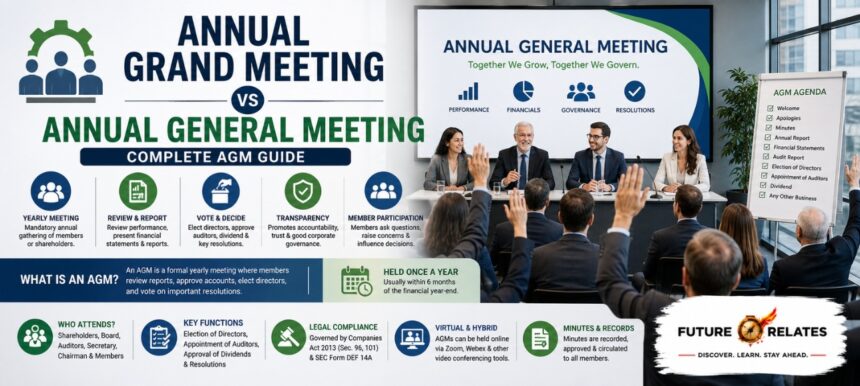

Every company, society, and charity eventually reaches that one date on the calendar where members gather, accounts get opened up, and decisions are made out loud. That gathering is the annual general meeting. And if you’ve ever searched for “Annual grand meeting,” you’re not alone. To be honest, both terms end up pointing to the same important event. Let’s walk through what it really means, who shows up, and how the whole thing runs.
- What Is an Annual General Meeting?
- Purpose of an Annual General Meeting
- Who Attends an AGM?
- Key Functions of an Annual General Meeting
- Shareholder Role in the Annual General Meeting
- Notice of Annual General Meeting
- Annual General Meeting Agenda Structure
- Quorum, Voting Procedure and Meeting Rules
- Documents Presented at an AGM
- Annual General Meeting for Companies, Societies and Associations
- Virtual and Hybrid Annual General Meetings
- Annual General Meeting Invitation Templates and Flyers
- Annual General Meeting Minutes and Post-Meeting Actions
- Annual General Meeting vs Extraordinary General Meeting
- Common AGM Questions
- Conclusion: Why Every Organization Needs a Well-Run AGM
What Is an Annual General Meeting?
Here’s a quick snapshot before we get into the detail.
|
Element |
Quick Answer |
|---|---|
|
What it is |
A yearly formal meeting of members/shareholders |
|
Who attends |
Shareholders, board, auditors, secretary, chairman |
|
How often |
Once a year (within 6 months of financial year-end in many jurisdictions) |
|
Notice period |
Usually 21 clear days |
|
Shorter notice |
Allowed with 95% consent |
|
Key laws |
Companies Act 2013 (Section 96, 101), SEC Form DEF 14A |
|
Quorum |
Often 2/3 or a fixed number like 20 members |
Definition of AGM
An annual general meeting (AGM) is the once-a-year formal gathering where an organization reports its performance to its members. Shareholders review the annual report, approve accounts, elect directors, and vote on resolutions. It’s mandatory for most companies and sits at the heart of good corporate governance.
Annual Grand Meeting vs Annual General Meeting
What’s interesting is that “annual grand meeting” isn’t an official legal term. People type it because it sounds impressive, but the correct phrase is annual general meeting. So if you searched for an annual grand meeting, you were really looking for the AGM. Same event, slightly different wording.
Why the AGM Matters in Corporate Governance
The AGM keeps leadership honest. It gives members a real chance to question the board, check the numbers, and shape big decisions. Without it, accountability quietly disappears.
Purpose of an Annual General Meeting
Reviewing Annual Performance
The meeting looks back at the year. Leadership presents what went well, what didn’t, and where the organization is heading next.
Presenting Financial Statements and Annual Reports
Members receive the annual report, balance sheet, and income and expenditure statement. These get formally adopted at the meeting, usually alongside the audit report.
Creating Transparency and Accountability
Here’s the thing — an AGM forces openness. When accounts are read aloud and questions get answered on record, trust grows. That transparency is exactly why regulators insist on it.
Who Attends an AGM?
Shareholders and Members
Shareholders and registered members form the core audience. In a society or club, they’d simply be called members. In a public company, they might include institutional and even activist investors.
Board of Directors and Executives
Directors, the chairman, and the executive team all attend. They present reports and answer questions directly.
Auditors, Secretary, Chairman and Committee Members
The auditors (or an independent examiner for charities) explain the financials. The company secretary handles records, the chairman presides, and committee members support the process.
Key Functions of an Annual General Meeting
Election of Directors
Members vote to appoint or re-elect directors. This is often the most closely watched item on the agenda.
Appointment or Reappointment of Auditors
Auditors are appointed or reappointed each year, keeping the financial checks independent and fresh.
Approval of Dividend, Compensation and Major Resolutions
Shareholders approve the dividend, sign off on executive compensation, and vote on big items like a merger or acquisition proposal.
Shareholder Role in the Annual General Meeting
Voting Rights and Proxy Voting
Every eligible shareholder gets voting rights. Can’t attend in person? Proxy voting lets someone vote on your behalf. In the US, this ties into the SEC’s Form DEF 14A proxy statement.
Asking Questions and Raising Concerns
The AGM is one of the rare moments where an ordinary member can look leadership in the eye and ask, “Why did this happen?” That direct line matters.
Influencing Company Decisions
One vote can tip a resolution. Collectively, shareholder voices steer real outcomes — from board seats to major strategy shifts.
Notice of Annual General Meeting
What an AGM Notice Must Include
A proper notice of annual general meeting lists the date, time, venue, and full agenda. Special business needs an explanatory statement so members understand what they’re voting on.
21-Day Notice Requirement and Shorter Notice Rules
Under the Companies Act 2013 (Section 101), companies must give 21 clear days’ notice. A shorter notice is allowed only if members holding at least 95% consent agree. Section 96, meanwhile, covers when the AGM must be held.
Email, Post, Website and Public Notice Methods
Notice can go out by email, post, website posting, or newspaper advertisement. Many organizations use a mix so nobody misses it.
Annual General Meeting Agenda Structure
Opening Remarks, Apologies and Minutes
The chairman opens with a welcome, apologies are noted, then the previous meeting’s minutes are approved and matters arising are handled.
Annual Report and Accounts Presentation
Next comes the main event: the annual report presentation, followed by adoption of the accounts and the audit report.
Resolutions, Elections and Any Other Business
Then come the resolutions, director elections, and auditor appointments. The meeting usually closes with “any other business” and final remarks.
Quorum, Voting Procedure and Meeting Rules
What Quorum Means
Quorum is the minimum number of members needed for the meeting to be valid. Some bylaws set it at 2/3 of members; others fix a plain number like 20 members.
How Voting Happens in Person and by Proxy
Votes can be cast in person, by proxy, or online. Each resolution needs a proposer and a seconder before it goes to a vote.
Casting Vote, Motions and Amendments
If a vote ties, the chairman may use a casting vote to break it. Members can also raise amendments to motions before the final show of hands.
Documents Presented at an AGM
Annual Report
The annual report tells the full story of the year — achievements, challenges, and direction.
Financial Statements and Balance Sheet
The balance sheet, income and expenditure report, and full financial statements are presented for adoption.
Audit Report, Explanatory Statement and Minutes
You’ll also see the audit report, any audit rectification report, the explanatory statement for special business, and the minutes of the previous meeting.
Annual General Meeting for Companies, Societies and Associations
Public and Private Company AGM
Public companies face stricter rules and heavier filings. Private companies still hold an AGM but with lighter formalities.
Society and Co-operative AGM Rules
A co-operative housing society or general body meeting follows its own constitution, with a set quorum and elected office bearers.
Charity and Voluntary Organization AGM Practices
Charities and voluntary groups use an independent examiner instead of a full audit when income is modest. Alumni and student societies often keep things simpler still.
Virtual and Hybrid Annual General Meetings
Zoom, Webex and Video Conferencing Formats
Virtual and hybrid AGMs took off recently. Platforms like Zoom and Webex let members join from anywhere.
Benefits of Virtual Attendance
More people show up. A meeting that once drew 300 attendees in person might now add 100 virtual attendees on top. Travel costs drop too.
Risks, Compliance and Meeting Security
The trade-off? You need secure online voting, verified identities, and a stable connection. Skip those, and someone could challenge the meeting’s legal validity.
Annual General Meeting Invitation Templates and Flyers
Invitation Wording Examples
Keep it clear: “You are cordially invited to the Annual General Meeting on Friday, 26th March, at 11:00 a.m.” Add the venue, agenda link, and RSVP details.
Flyer and Poster Design Elements
A good AGM flyer includes the date, time, location, logo, and a registration link. Common print sizes are A4, A5, and US Letter (11in × 8.5in).
Visual Assets for Annual Meeting Promotions
Banners, posters, and email headers help spread the word. A clean corporate design gets more members to actually turn up.
Annual General Meeting Minutes and Post-Meeting Actions
Drafting and Approving Minutes
The secretary drafts minutes during the meeting. These become the official record once approved at the next session.
Recording Resolutions and Action Items
Every resolution, vote count, and action item gets written down. This protects the organization if anything is questioned later.
Circulating Final Minutes to Members
Final minutes are shared with members, often by email or a PDF on the website, closing the loop neatly.
Annual General Meeting vs Extraordinary General Meeting
Key Differences in Timing
An AGM happens once a year on a fixed schedule. An extraordinary general meeting (EGM) is called whenever an urgent issue can’t wait.
Difference in Purpose and Agenda
The AGM covers routine ordinary business — accounts, elections, dividends. An EGM tackles one pressing matter, like a sudden merger or a governance crisis.
When an EGM Is Required
Boards or shareholders holding enough voting power (often around 2% paid-up share capital or more) can demand an EGM when something serious lands.
Common AGM Questions
Can an AGM Be Held Online?
Yes. Virtual and hybrid AGMs are widely accepted now, provided voting and attendance rules are properly followed.
Who Can Vote at an AGM?
Registered shareholders and eligible members vote, either in person or through proxy voting.
What Happens if Quorum Is Not Met?
If quorum isn’t reached, the meeting can’t legally proceed. It’s usually adjourned and rescheduled.
Conclusion: Why Every Organization Needs a Well-Run AGM
Governance, Trust and Compliance Benefits
A well-run annual general meeting keeps an organization compliant, transparent, and trusted. It satisfies the law and reassures members that their interests are being watched.
How AGM Planning Improves Member Participation
Good planning — clear notice, a tight agenda, and easy virtual access — brings more people to the table. And when members show up and speak up, the whole organization grows stronger.
For More Information Visit: https://futurerelates.co.uk/