

So you need to know the date 180 days from today. Maybe it’s a deadline, a visa rule, or just a personal goal you’re counting down to. Whatever the reason, this guide breaks it all down — the exact date, the math behind it, the Excel tricks, and a few smart ways to plan those six months. Let’s get into it.
- What Date Is 180 Days From Today?
- How Many Weeks, Months, and Hours Are in 180 Days?
- How to Calculate 180 Days From Today Manually
- How to Use an Online Date Calculator
- How to Calculate 180 Days From Today in Excel
- 180 Days From Today vs 180 Business Days From Today
- Is 180 Days the Same as 6 Months?
- Common Reasons People Search for 180 Days From Today
- Business Uses for a 180-Day Calculation
- Personal Uses for a 180-Day Countdown
- Common Mistakes When Counting 180 Days
- Tips to Plan the Next 180 Days Effectively
- FAQs About 180 Days From Today
- Final Thoughts on Calculating 180 Days From Today
What Date Is 180 Days From Today?
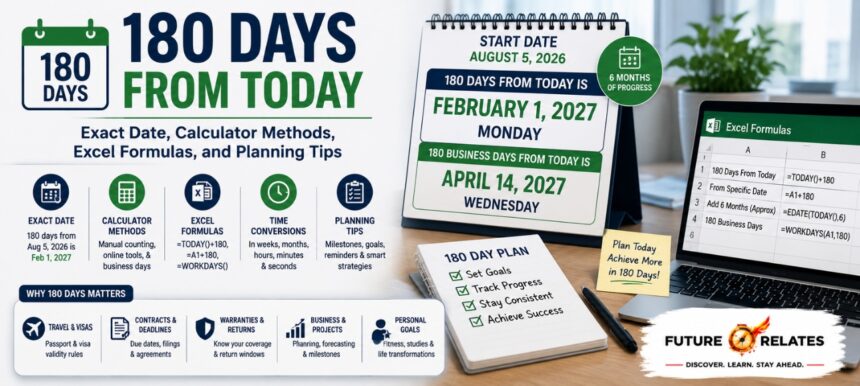
Here’s the thing — the answer depends on your starting point. Using August 5, 2026 as today’s date, counting forward 180 days lands you on a clear future date.
|
Detail |
Answer |
|---|---|
|
Start date |
August 5, 2026 |
|
Days added |
180 |
|
Exact date (calendar) |
February 1, 2027 |
|
Day of the week |
Monday |
|
180 business days |
April 14, 2027 (Wednesday) |
|
In weeks |
25.714 weeks |
|
In months |
About 5.87 months |
|
In hours |
4,320 hours |
Exact calendar date
Counting 180 calendar days from August 5, 2026 gives you Monday, February 1, 2027. Every single day counts here — weekends, holidays, all of it.
Day of the week
That target date falls on a Monday. Small detail, but handy if you’re scheduling a meeting or a launch and want to avoid a weekend.
Quick-answer summary box
Quick recap: 180 days from today (August 5, 2026) = February 1, 2027, a Monday. If you only need weekdays, it shifts to April 14, 2027.
How Many Weeks, Months, and Hours Are in 180 Days?
Sometimes you don’t just want a date. You want to picture the stretch of time itself.
180 days in weeks
Divide 180 by 7 and you get 25.714 weeks. Roughly 25 weeks and 5 days. That’s a solid chunk — think about how much can change in half a season.
180 days in months
On average, 180 days works out to about 5.87 months, or near enough to 5 months and 27 days. Not quite six full months, and that gap matters more than people expect.
180 days in hours, minutes, and seconds
For the number lovers: 180 days equals 4,320 hours, 259,200 minutes, and a whopping 15,552,000 seconds. Kind of puts a countdown into perspective, right?
How to Calculate 180 Days From Today Manually
You don’t always need a tool. A calendar and a bit of patience will do.
Count by remaining days in each month
Start from your current date. Count the days left in this month, then add full months as you go until the total hits 180. From August 5, you’d tick off the rest of August, then September, October, November, December, January — and finish a few days into February.
Count week by week
Prefer bigger jumps? Count in weeks. Twenty-five weeks gets you close, then add the final 5 days by hand. It’s faster than counting one day at a time and less likely to lose your place.
Why manual counting can go wrong
To be honest, manual counting trips people up. You might miscount month lengths, forget February has 28 days (or 29 in a leap year), or accidentally count the start date as day one instead of day zero. Little errors add up quick.
How to Use an Online Date Calculator
Fastest way to verify the answer
An online date calculator is the quickest safety net. Type in your start date, enter 180, and it spits out the exact date instantly. No mental math, no slip-ups.
When a calculator is better than counting manually
If your date crosses a leap year or you need business days only, a calculator wins every time. It handles the tricky parts automatically, which saves you from second-guessing.
How to Calculate 180 Days From Today in Excel
Spreadsheets make this almost effortless. Here are the formulas worth knowing.
Use =TODAY()+180
Type =TODAY()+180 into any cell. Excel grabs the current date and adds 180 days on the spot. It updates itself daily, so it’s great for live countdowns.
Use =A1+180 for a custom start date
Got a specific start date in cell A1? Use =A1+180. This is perfect when you’re calculating from a contract date or an order date rather than today.
Use =EDATE(TODAY(),6) and when not to
=EDATE(TODAY(),6) adds six calendar months instead of 180 days. What’s interesting is these two won’t always match. EDATE respects month lengths, so it can land a day or two off from a straight 180-day count. Use it when you truly mean “six months,” not “180 days.”
How to adjust for weekends and holidays
Need working days only? The WORKDAYS (or WORKDAY) function skips weekends and any holidays you list. That’s how you’d get 180 business days instead of plain calendar days.
180 Days From Today vs 180 Business Days From Today
What counts as a business day
A business day is a regular weekday — Monday through Friday. Weekends are out.
Why weekdays give a different result
This is where numbers split apart. 180 calendar days from August 5, 2026 is February 1, 2027. But 180 business days lands all the way on April 14, 2027. That’s over two months later, because you’re skipping every Saturday and Sunday.
How holidays affect the calculation
Toss in public holidays and the business-day result stretches even further. Every holiday you exclude pushes the final date forward by one more day.
Is 180 Days the Same as 6 Months?
Why the answers may differ
Not exactly. Six months can be anywhere from 181 to 184 days depending on which months you cross. So 180 days usually lands a touch short of a true six-month mark.
Month length and leap year effects
Months aren’t equal — February has 28 days, April has 30, and January has 31. A leap year adds February 29 into the mix, nudging your count. These small differences are why “180 days” and “6 months” rarely line up perfectly.
Examples that show the difference
From August 5, 2026, adding six months with EDATE gives February 5, 2027. But 180 exact days gives February 1, 2027 — four days apart. Same idea, different answers.
Common Reasons People Search for 180 Days From Today
Deadlines and due dates
Lots of contracts, invoices, and filings run on a 180-day clock. People check the exact due date so nothing slips past.
Travel, passport, and visa rules
Plenty of countries need your passport valid for at least 180 days beyond arrival. Travelers count forward to confirm they’re covered.
Warranties, returns, and contracts
Return windows and warranty periods often sit at 180 days. Knowing the exact expiration date protects you from missing it.
Events, weddings, and anniversaries
A six-month countdown is popular for weddings and big celebrations. Couples pin the date and build their timeline around it.
Business Uses for a 180-Day Calculation
Project management timelines
Half-year project sprints often run on a 180-day plan, with clear start and end dates.
Financial reporting and forecasting
Semi-annual reports and budgeting cycles lean on this window. Finance teams forecast six months out using it.
Employee probation and review periods
Many companies set probation at 180 days. HR marks the review date to schedule check-ins.
Compliance and filing windows
Regulatory deadlines frequently allow a 180-day filing period. Missing it can mean penalties, so the exact date matters.
Personal Uses for a 180-Day Countdown
Fitness and habit goals
A six-month fitness challenge gives real time for change. People track weight, strength, or running goals across those 180 days.
Study plans and certifications
Exam prep and course schedules map neatly onto a 180-day plan, breaking study into steady chunks.
Recovery, appointments, and check-ins
Doctors often set follow-ups around the six-month point. Marking it helps you stay on schedule.
Six-month personal transformation plans
What stands out is how many people use 180 days for a full reset — new habits, savings goals, a side hustle. Half a year is long enough to see real progress.
Common Mistakes When Counting 180 Days
Confusing 180 days with 6 months
The biggest slip. They’re close but not identical, and that gap can throw off a deadline.
Forgetting leap years
February 29 sneaks in every four years. Ignore it and your count drifts by a day.
Ignoring weekends and holidays
If you needed business days but counted calendar days, you’ll be off by weeks.
Using the wrong date format
Mixing up MM/DD and DD/MM formats causes real confusion, especially across regions. Double-check your settings.
Tips to Plan the Next 180 Days Effectively
Break 180 days into 60-day milestones
Split the stretch into three 60-day blocks. Smaller targets feel doable and keep momentum going.
Set a 90-day midpoint review
Halfway through, pause and check your progress. A 90-day review shows whether you’re on track or need to adjust.
Add reminders and calendar alerts
Drop the key dates into Google Calendar with alerts. Set-and-forget beats relying on memory.
Track progress with a spreadsheet
A simple spreadsheet with your start date, milestones, and a =A1+180 formula keeps everything visible in one place.
FAQs About 180 Days From Today
What is 180 days from today?
Counting from August 5, 2026, it’s Monday, February 1, 2027 — all calendar days included.
What is 180 business days from today?
Skipping weekends, 180 business days from August 5, 2026 lands on Wednesday, April 14, 2027.
How do I add 180 days in Excel?
Use =TODAY()+180 for today’s date, or =A1+180 if your start date sits in cell A1.
Is 180 days exactly half a year?
Almost, but not quite. Half a year is closer to 182–183 days, so 180 days falls a little short.
Final Thoughts on Calculating 180 Days From Today
When precision matters most
For legal deadlines, visas, and compliance, exact counting isn’t optional. A day off could cost you.
Best method for fast and accurate planning
For speed and zero errors, lean on Excel or an online date calculator. Manual counting is fine for a rough idea, but when the date really counts, let the formula do the work. Either way, knowing exactly what falls 180 days from today puts you in control of the next six months.
For More Information Visit: https://futurerelates.co.uk/