
Introduction: Why the London Riots Still Matter
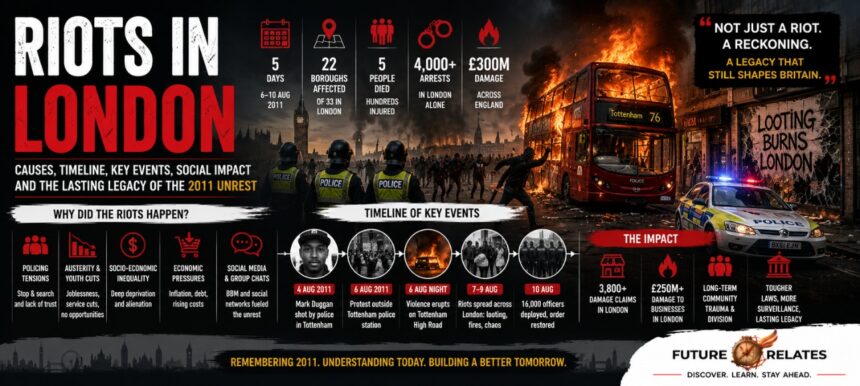
More than a decade on, people still ask what really happened during the riots in London. And here’s the thing — it wasn’t one single event. It was five hot August days in 2011 that shook the country, spread through 22 of London’s 33 boroughs, and left five people dead.
- Introduction: Why the London Riots Still Matter
- What Were the London Riots?
- How the London Riots Began in Tottenham
- How the Riots Spread Across London
- Which Areas Were Most Affected by the London Riots?
- What Caused the London Riots?
- The Role of Looting, Opportunism and Crowd Psychology
- Police Response During the London Riots
- Firefighters, Emergency Services and Public Safety
- Arrests, Courts and Sentencing After the Riots
- The Human and Economic Impact of the London Riots
- Youth Services, Forgotten Families and the Social Fallout
- How the London Riots Changed Protest Policing
- London Riots vs Later UK Unrest
- Historical Context: From Broadwater Farm to the Gordon Riots
- What Lessons Were Learned From the London Riots?
- Conclusion: The Legacy of the London Riots in Modern Britain
- FAQs About the London Riots
The riots in London remain one of the most studied moments of civil unrest in modern British history. Why? Because they exposed something uncomfortable about trust, policing, and the gap between rich and poor. To be honest, the questions raised back then still don’t have tidy answers.
|
Quick Facts |
Detail |
|---|---|
|
Start date |
6 August 2011, Tottenham |
|
Trigger |
Fatal police shooting of Mark Duggan |
|
Boroughs hit |
22 of 33 in London |
|
Deaths |
5 people |
|
Arrests |
Over 4,000 in London alone |
|
Property damage |
Around £300m across England |
|
Damage claims |
More than 3,800 in London |
|
Officers deployed |
Up to 16,000 on London’s streets |
What Were the London Riots?
A brief definition of the 2011 London riots
The 2011 London riots were a wave of looting, arson, and street violence that began in Tottenham and spread fast across the capital. Rioters smashed shopfronts, torched buses and cars, and cleared out stores in a matter of hours. What started as a protest turned into large-scale public disorder.
Why the unrest quickly became a national story
The riots in London didn’t stay in London. Copycat unrest broke out in Birmingham, Liverpool, Manchester, Salford, and Bristol. Live television carried burning buildings into millions of homes. That’s when it stopped being a local story and became a national reckoning.
How the London Riots Began in Tottenham
The police shooting of Mark Duggan
It started with one death. Mark Duggan, a 29-year-old father of four, was shot dead by Metropolitan Police officers on 4 August 2011. The circumstances were disputed from the start, and that uncertainty poured fuel on already fractured relations between local communities and the police.
The protest outside Tottenham police station
Two days later, on 6 August, Duggan’s family and neighbours gathered outside Tottenham police station. They wanted answers. The demonstration was peaceful at first — a community asking to be heard.
How peaceful protest turned into violent disorder
By nightfall, everything changed. Anger spilled over on Tottenham High Road. Cars burned, windows shattered, and the first riots in London took hold. What’s interesting is how quickly the mood flipped from grief to open confrontation.
How the Riots Spread Across London
Hackney, Brixton, Peckham and Croydon
Within 48 hours, the unrest jumped boroughs. Hackney’s Mare Street and Clarence Road saw running clashes. Brixton, Peckham, and Croydon followed. Around 15,000 people took to the streets across the capital.
Looting, arson and attacks on shops and buses
Shops were ransacked. Buses were torched. Small family businesses lost everything in a single night. The looting felt less about protest and more about opportunity — and that shift troubled a lot of observers.
Why police struggled to regain control
The Metropolitan Police were simply outnumbered early on. With flashpoints erupting everywhere at once, officers couldn’t hold every line. That delay let the riots in London gather dangerous momentum.
Which Areas Were Most Affected by the London Riots?
Tottenham High Road and surrounding neighborhoods
Tottenham took the first and heaviest hit. The High Road became a symbol of the whole event — scorched, boarded up, and grieving.
Croydon fires and business destruction
Croydon town centre saw some of the worst fires. Long-standing local businesses burned to the ground, and images from that night became some of the most haunting of the whole period.
Clapham Junction, Ealing, Lewisham and Enfield
Clapham Junction faced heavy looting. Ealing, Lewisham, and Enfield all recorded serious disorder too. Few corners of the city felt untouched.
What Caused the London Riots?
Immediate trigger: anger after Mark Duggan’s death
The spark was clear — anger over Duggan’s death and how police handled it. But a spark needs dry ground to catch.
Long-term tensions with policing and stop and search
For years, stop and search had strained police-community relations. Black people were far more likely to be stopped — around nine times more, by some measures. That resentment ran deep.
Austerity, youth service cuts and unemployment
Then came austerity. Budget cuts hit hard, roughly one million people aged 16 to 24 were unemployed, and opportunities were shrinking. Many young people felt written off.
Social inequality, deprivation and alienation
Inequality was stark. In parts of Hackney, around 67% of children lived in low-income families. When the richest 10% are more than 100 times wealthier than the poorest, alienation doesn’t need much encouragement.
The Role of Looting, Opportunism and Crowd Psychology
Why some saw criminality while others saw social breakdown
Politicians called it “pure criminality.” Community voices saw social breakdown. Honestly, both readings hold pieces of the truth — it was messy and human.
How copycat behavior spread across boroughs
Crowd psychology matters. Once one area erupted, others followed almost overnight. The sense that “everyone’s doing it” lowered the barrier for many.
The role of social media and BlackBerry Messenger
BlackBerry Messenger (BBM) played a quiet but huge role. Its private, encrypted messages helped groups coordinate faster than police could track. Twitter carried rumours too. This was one of the first UK crises shaped by digital coordination.
Police Response During the London Riots
Metropolitan Police tactics and operational failures
Early on, tactics looked hesitant. Officers held back, unsure whether to charge or contain. That caution, fair or not, was later criticised heavily.
Section 60 stop and search powers
Police leaned on Section 60 powers, allowing searches without specific suspicion. It was a blunt tool that deepened old tensions.
Why 16,000 officers were eventually deployed
Numbers finally turned things around. From roughly 6,000 officers, the Met scaled up to about 16,000 on London’s streets, backed by 1,700 extra officers. Order returned — but slowly.
Firefighters, Emergency Services and Public Safety
London Fire Brigade under intense pressure
The London Fire Brigade faced one of its toughest weeks ever. Crews raced from blaze to blaze with barely a pause.
Emergency call volumes, blazes and mobility challenges
The scale was staggering — more than 5,000 emergency calls, roughly one call every 48 seconds at peak, and about one blaze every nine minutes. Getting engines through blocked, burning streets was a challenge in itself.
Lessons learned for future public order events
The strain exposed gaps in how emergency services coordinate during mass unrest. Those lessons shaped later planning for public order events.
Arrests, Courts and Sentencing After the Riots
How thousands were arrested and charged
The response was sweeping. Over 4,000 people were arrested in London alone, part of more than 3,000-plus arrests nationally, with thousands charged.
24-hour courts and emergency justice
Courts opened around the clock. These 24/7 magistrates’ sessions pushed cases through at record speed.
Debates over harsh sentencing and civil liberties
Sentences ran, on average, about four and a half times longer than usual for similar offences. More than 2,000 jail terms followed. Critics warned this “emergency justice” bent civil liberties out of shape.
The Human and Economic Impact of the London Riots
Deaths, injuries and trauma
Five people lost their lives. Hundreds of police officers were injured. The trauma lingered long after the smoke cleared.
Damage to homes, shops and local livelihoods
Property damage reached around £300m across England, with £250m in London’s shops and businesses alone. More than 3,800 damage claims were filed in the capital.
How communities were left with long-term scars
Some families never reopened their shops. The riots in London left scars that money couldn’t quickly repair.
Youth Services, Forgotten Families and the Social Fallout
Cuts to youth centres and youth worker roles
The fallout hit young people hardest. Youth services faced a 44% budget cut, with £36m stripped away, 110-plus youth centres closed, and more than 600 youth worker jobs lost.
Why support needs remained high 10 years later
Ten years on, the need hadn’t gone anywhere. Around 500,000 “forgotten families” still needed real support that never fully arrived.
What inquiry recommendations were ignored
The Riots Communities and Victims Panel made more than 60 recommendations. Only around 11 were meaningfully implemented. That gap says a lot.
How the London Riots Changed Protest Policing
From emergency justice to tougher protest controls
After 2011, the state leaned toward tougher control. Emergency justice set a template that later shaped protest policing.
Surveillance, crackdown politics and public order powers
Surveillance grew. Facial recognition, intelligence-led policing, and stronger public order powers all expanded in the years that followed.
Why the riots remain a turning point in policing
For many, the riots in London marked a clear turning point — the moment British policing shifted toward a firmer, more watchful posture.
London Riots vs Later UK Unrest
Comparing the 2011 riots with 2024 far-right unrest
The 2024 unrest looked different. It was driven by far-right, anti-immigration anger after the Southport tragedy, with over 400 arrests. The 2011 riots grew from local grievance and deprivation, not organised extremism.
What changed in public anger, targets and political rhetoric
In 2011, targets were shops and police. In 2024, the anger aimed at migrants and asylum seekers. The rhetoric had shifted sharply.
How anti-racist counter-protests reshaped the public response
What stands out in 2024 is the pushback — more than 5,000 anti-racist counter-protesters gathered in Walthamstow alone. Community solidarity became the headline, not just the violence.
Historical Context: From Broadwater Farm to the Gordon Riots
Earlier London flashpoints and what they reveal
The 2011 riots in London weren’t the first. The 1985 Broadwater Farm riots, also in Tottenham, followed a similar mix of a death and long-standing mistrust.
Why London has a long history of riot-related unrest
Go back further and you reach the Gordon Riots of June 1780, when tens of thousands filled the streets and hundreds died. London, it turns out, has a long memory for unrest.
What Lessons Were Learned From the London Riots?
Policing lessons
Speed and numbers matter, but so does trust. Heavy-handed stop and search can cost more than it gains.
Social policy lessons
Cutting youth services and ignoring deprivation carries a price — sometimes a very visible one.
Community trust and prevention lessons
Prevention beats reaction. Real community trust, built slowly, is the best defence against future disorder.
Conclusion: The Legacy of the London Riots in Modern Britain
The riots in London were never just about one shooting or one week in August. They were about frustration that had been building for years — over policing, poverty, and being unheard. The legacy sits in tougher public order laws, more surveillance, and a lingering debate about whether Britain fixed anything at all. To be honest, the answer feels uncomfortably open.
FAQs About the London Riots
When did the London riots start?
They began on 6 August 2011 in Tottenham and lasted around five days.
Who was Mark Duggan?
Mark Duggan was a 29-year-old father of four, shot dead by Metropolitan Police on 4 August 2011. His death triggered the unrest.
How many people died in the London riots?
Five people died during the riots, and hundreds of police officers were injured.
How much damage did the London riots cause?
Around £300m in property damage across England, with roughly £250m in London businesses and more than 3,800 damage claims in the capital.
What was the long-term impact of the riots?
Tougher protest policing, expanded surveillance, deep youth service cuts, and a lasting debate about inequality and community trust.
For More Information Visit: https://futurerelates.co.uk/