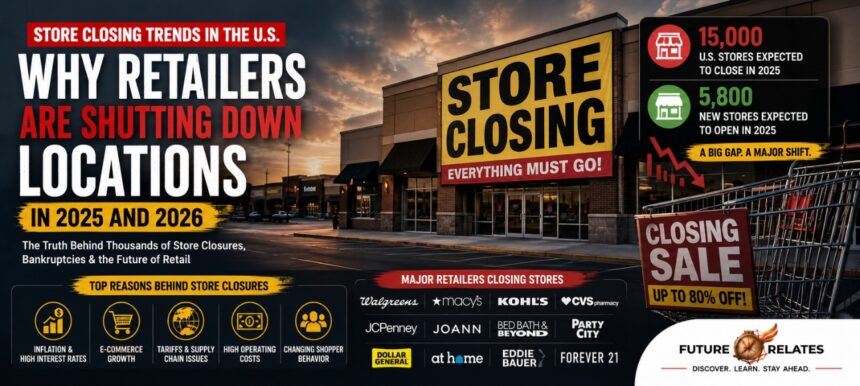

Drive past any strip mall lately and you’ll probably spot at least one “Store Closing” banner in a window. It’s become a familiar sight. A store closing here, a whole chain winding down there. And it’s not slowing down. Analysts at Coresight Research expect around 15,000 U.S. stores to close in 2025, while only about 5,800 new ones open. That gap tells you a lot about where retail is headed.
- What Does “Store Closing” Mean in Today’s Retail Market?
- Why Are So Many Stores Closing in 2025 and 2026?
- The Biggest Retail Store Closing Trends Across the U.S.
- Which Major Brands Are Closing Stores?
- Store Closures and Chapter 11 Bankruptcy: What’s the Connection?
- The Hidden Cost of Closing Stores
- How Store Closures Affect Local Communities
- Why Underperforming Stores Are Still Hard to Close
- What Retailers Are Doing Instead of Mass Closures
- Store Openings vs Store Closings: What the Numbers Show
- What the Future of Physical Retail Looks Like
- Final Takeaway: What “Store Closing” Really Signals for Retail
Here’s the thing, though. This isn’t just a story about failure. It’s a story about pressure, change, and how shopping itself keeps shifting. Prices went up. People started buying more online. Big chains carrying heavy debt ran out of room to breathe. So they trimmed. And a store closing became one of the most common headlines in retail.
Let’s walk through what’s really going on.
What Does “Store Closing” Mean in Today’s Retail Market?
A store closing sounds simple, but it comes in a few flavors. Some are permanent. Others are more of a reshuffle than a shutdown.
|
Type of Closure |
What It Actually Means |
Common Example |
|---|---|---|
|
Permanent closure |
The location shuts for good |
Bed Bath & Beyond, Party City |
|
Store liquidation |
Everything sold off, often via bankruptcy |
Eddie Bauer, Forever 21 |
|
Downsizing |
Cutting weak stores, keeping strong ones |
Macy’s, Kohl’s |
|
Restructuring |
Reorganizing debt while staying open |
Chapter 11 filers |
|
Footprint optimization |
Strategic trimming, not distress |
CVS, Walgreens |
Permanent closures vs temporary shutdowns
A permanent store closure means the doors don’t reopen. A temporary shutdown, on the other hand, might just be a remodel or a short pause. Most of what we’re seeing in 2025 falls into the permanent camp, which is why the numbers feel so heavy.
Store liquidation, downsizing, and restructuring differences
Liquidation is the harsh one. Inventory gets sold, sometimes at 39 cents on the dollar, and the brand often disappears. Downsizing is calmer. A retailer just closes its underperforming stores and keeps the winners. Restructuring sits in the middle, usually tied to a court process.
Why Are So Many Stores Closing in 2025 and 2026?
To be honest, there’s no single villain here. It’s a pileup of pressures.
Inflation, interest rates, and operating cost pressure
Rising costs squeezed margins for years. High interest rates made debt harder to service. When rent, wages, and borrowing all climb at once, weak stores stop pulling their weight. That’s when a store closing starts to look like the only sensible move.
E-commerce growth and digital shopping behavior
Online shopping keeps eating into foot traffic. Shoppers migrated to digital channels, and players like Amazon, Shein, and Temu made it easy. Fewer people walking in means fewer reasons to keep a struggling location open.
Tariffs, supply chain friction, and margin compression
What’s interesting is how much tariff uncertainty added to the mess. Import costs wobbled, supply chains stayed unpredictable, and margins got thinner. For chains already carrying debt, that extra pressure tipped the scales toward closures.
The Biggest Retail Store Closing Trends Across the U.S.
Some sectors are getting hit harder than others.
Department stores reducing their footprint
Macy’s is trimming around 150 underproductive stores by 2026, with 66 closing in 2025 alone. Nordstrom, Dillard’s, and Neiman Marcus have all faced similar pressure. Department stores simply built too many locations for how people shop now.
Pharmacy and discount retailers trimming locations
Walgreens plans roughly 1,200 closures over three years, with about 500 in fiscal 2025, out of its 8,700 U.S. locations. CVS is closing around 900. Dollar General shut 96 stores and 45 Popshelf shops. Reimbursement pressure and thin margins pushed the whole pharmacy space to rightsize.
Grocery chains closing underperforming stores
Grocery isn’t immune either. Albertsons closed 2 locations in North Texas. Save A Lot expects to close 7 stores in Chicago. Grocery Outlet shuttered 36 stores even while opening 42 new ones. That mix says a lot.
Which Major Brands Are Closing Stores?
Here’s a quick roll call of the big names.
Walgreens, Macy’s, Kohl’s, CVS, and JCPenney
Walgreens (1,200), CVS (900), and Macy’s (up to 150) lead the pack. Kohl’s is closing 27 locations. JCPenney keeps reviewing its store fleet under its Catalyst Brands umbrella.
Joann, Party City, Claire’s, and At Home
Joann is closing all 800 stores across 49 states, which stung crafters everywhere. Party City is winding down about 700 locations. Claire’s listed 290-plus closures, and At Home is closing 26.
Eddie Bauer, REI Co-op, and specialty retail brands
Eddie Bauer is liquidating around 175 stores, with a 13-week window for some. REI Co-op is closing just 3 stores, a small trim for a healthy brand. Orvis is closing 31 full-price shops. Even Forever 21 is closing 350 globally.
Store Closures and Chapter 11 Bankruptcy: What’s the Connection?
There were 43 retail bankruptcies in 2024, up from 25 in 2023. That jump matters.
How bankruptcy leads to liquidation and restructuring
A Chapter 11 filing gives a retailer breathing room to renegotiate debt. Sometimes it works, and the chain survives leaner. Other times lenders lose patience, and it turns into full liquidation. Big Lots, American Freight (329 stores), and Party City all traveled this road.
Why some chains close stores before full bankruptcy filings
Smart operators close weak stores early. Cutting fixed costs before a court gets involved can preserve the healthy parts of the business. It’s less dramatic than bankruptcy, and it buys time.
The Hidden Cost of Closing Stores
Closing a store saves rent. But it costs other things people forget about.
Lost customer loyalty and brand trust
When a familiar store closes, some shoppers just leave the brand entirely. Loyalty is fragile, and a shuttered location can quietly chip away at trust.
The halo effect and horn effect on online sales
Physical stores boost nearby online sales, something analysts call the halo effect. New store openings can lift local online sales by around 7%. Close a store, though, and the horn effect kicks in. Online sales in that trading area can drop 12% to 22%.
Why closing a store can hurt digital revenue too
So a store closing isn’t purely a physical loss. It can drag down the digital side of the business in the same region. That surprises a lot of people.
How Store Closures Affect Local Communities
This part gets personal for a lot of neighborhoods.
Food deserts and reduced grocery access
When a grocery store closes in areas like Chicago’s South Side or West Side, whole neighborhoods lose easy food access. Places like Englewood and Morgan Park have felt this hard. A closure can create a food desert almost overnight.
Job loss, neighborhood decline, and transportation barriers
Store closures mean layoffs. They also mean longer trips for basic shopping, especially for folks without cars. Empty storefronts drag down the feel of a whole street.
Why store closures hit low-income areas hardest
Lower-income neighborhoods often rely more on nearby stores and SNAP benefits. When those stores vanish, the burden lands hardest on people with the fewest options.
Why Underperforming Stores Are Still Hard to Close
You’d think closing a weak store is easy. It usually isn’t.
Fixed cost savings vs long-term revenue loss
Yes, you save on rent and staff. But you might lose loyal customers, local visibility, and that halo effect on online orders. The math isn’t always as clean as it looks on a spreadsheet.
The role of trading area demand and in-person discovery
Some shoppers still love browsing in person. In-person discovery drives impulse buys and brand connection. Close the store, and you lose that touchpoint for good.
What Retailers Are Doing Instead of Mass Closures
Not everyone is running scared. Plenty are adapting.
Omnichannel strategy and digital integration
Smart chains blend stores with digital channels. Stores double as mini fulfillment centers. That’s omnichannel retail done right, and it keeps physical locations useful.
Pricing strategy, operational efficiency, and footprint optimization
Instead of slashing everything, some retailers tighten pricing, trim operating costs, and optimize their footprint carefully. Leslie’s, for example, posted a 6.6% comparable sales bump in one quarter after focusing its operations.
Measured expansion in stronger markets
Growth hasn’t stopped. Aldi, Costco, and BJ’s Wholesale Club keep opening. Measured expansion in strong markets beats mass closures in weak ones.
Store Openings vs Store Closings: What the Numbers Show
Let’s look at the scoreboard.
Closure forecasts, openings slowdown, and retail imbalance
Around 15,000 closures are projected for 2025 against roughly 5,800 openings. In 2024, closures hit about 7,325. UBS even projects 45,000 closures over five years. The imbalance is real.
Which chains are still expanding despite industry pressure
Discount grocers, warehouse clubs, and value players keep growing. Grocery Outlet opened 42 stores in 2025. Aldi keeps adding locations. Value wins when wallets are tight.
What the Future of Physical Retail Looks Like
Physical retail isn’t dying. It’s changing shape.
Why brick-and-mortar still matters
People still want to touch products, get things instantly, and enjoy the social side of shopping. Stores offer immediate gratification that shipping can’t match.
Which retailers are most likely to survive and grow
Value-driven, efficient, omnichannel brands look safest. Think Costco, Aldi, and lean specialty players like REI that close only what they must.
How physical stores are evolving in an e-commerce era
Stores are becoming pickup points, showrooms, and community hubs. The store closing wave is really a sorting process, separating stores that add value from ones that don’t.
Final Takeaway: What “Store Closing” Really Signals for Retail
Retail is not disappearing, but it is reshaping
Every store closing banner tells part of a bigger story. Retail isn’t vanishing. It’s getting rebuilt around how people actually shop today.
The winners will adapt faster than the market changes
The chains that survive won’t be the biggest. They’ll be the ones that adapt fastest, blend digital with physical, and stay honest about which stores truly earn their keep. That’s the real lesson behind the store closing trend of 2025 and 2026.
For More Information Visit: https://futurerelates.co.uk/