
If you’ve ever wondered how a small coffee shop or an online store starts accepting card payments, there’s usually a middleman doing the heavy lifting. That middleman is often an independent sales organization. Here’s the thing: most business owners never see this part of the payment world, yet it quietly powers a huge chunk of everyday transactions.
- What Is an Independent Sales Organization?
- How Does an Independent Sales Organization Work?
- What Does an ISO Do in the Payments Industry?
- Independent Sales Organization vs MSP: What’s the Difference?
- Independent Sales Organization vs Bank vs Payment Processor
- Benefits of Working With an Independent Sales Organization
- Potential Drawbacks of Using an ISO
- How ISOs Make Money
- How to Choose the Right Independent Sales Organization
- How to Verify a Registered ISO or MSP
- How to Become an Independent Sales Organization
- Costs and Requirements to Become an ISO
- How to Become a Successful ISO Agent
- Best Industries for Independent Sales Organizations
- FAQs About Independent Sales Organizations
- Final Thoughts on Independent Sales Organizations
This guide breaks it all down in plain language. We’ll cover what an independent sales organization actually does, how the money flows, the fees involved, and what it takes to start one yourself. Whether you’re a merchant hunting for a payment partner or someone curious about joining the ISO business, you’ll walk away with a clear picture.
What Is an Independent Sales Organization?
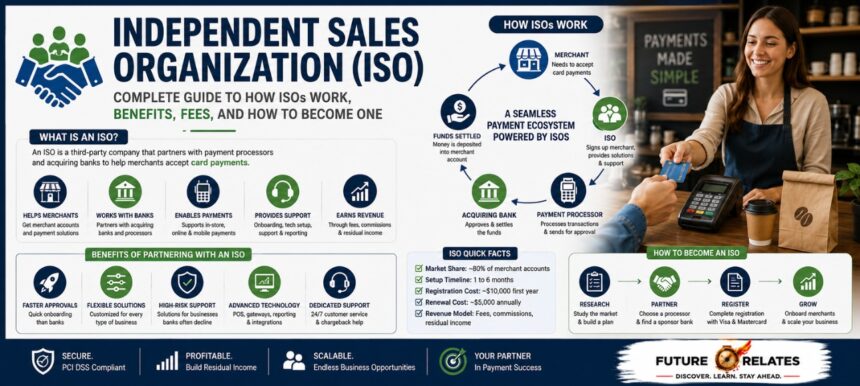
An independent sales organization, or ISO, is a third-party company that connects merchants with payment processors and acquiring banks. In simple terms, it helps businesses get a merchant account so they can accept credit and debit cards.
|
Quick Reference |
Details |
|---|---|
|
What it is |
Third-party firm linking merchants to processors and banks |
|
Also called |
ISO/MSP, Merchant Service Provider |
|
Main role |
Reseller of merchant services and payment technology |
|
Registration cost |
~$10,000 first year, ~$5,000 annual renewal |
|
Setup timeline |
1 to 6 months |
|
Market share |
Roughly 80% of merchant accounts are opened through ISOs/MSPs |
|
Income model |
Transaction fees, commissions, residual income |
Independent sales organization definition
At its core, an ISO is a reseller. It doesn’t process payments itself. Instead, it partners with a payment processor and an acquiring bank, then sells those services to merchants under its own brand or a co-branded setup.
What ISO means in payment processing
In payment processing, the ISO sits between the business and the acquiring bank. It handles sales, onboarding, merchant support, and often the tech setup like a POS system or payment gateway. Think of it as the friendly face of a much bigger machine.
Why ISOs matter in merchant services
What’s interesting is how much of the market runs through them. Around 80% of merchant accounts are opened by ISOs or MSPs. Banks can be slow and picky, so ISOs fill the gap with faster approvals and more personal service.
How Does an Independent Sales Organization Work?
The workflow looks complicated at first, but it follows a clear chain.
The relationship between merchants, ISOs, processors, and acquiring banks
Picture four players: the merchant, the ISO, the payment processor, and the acquiring bank. The merchant wants to accept cards. The independent sales organization signs them up, the processor moves the transaction data, and the acquiring bank settles the funds. Everyone plays a role.
How merchant account setup and onboarding work
Onboarding starts with an application. The ISO collects business details, then the underwriting team reviews risk. Once approved, the merchant gets an account. To be honest, this is where a good ISO shines, because they smooth out the paperwork and friction.
How ISOs support payment acceptance
After setup, the ISO helps the business go live. That means configuring terminals, connecting online gateways, and making sure card acceptance works across in-store, mobile, and eCommerce channels.
What Does an ISO Do in the Payments Industry?
An independent sales organization wears a lot of hats. Its job doesn’t end after the sale.
Merchant account assistance
They guide merchants through account setup, approval, and activation. If a business gets flagged during underwriting, the ISO often steps in to sort it out.
Payment gateway and POS support
ISOs supply the tools too, from POS systems and virtual terminals to mobile card readers and payment gateways. Many offer integrations with software like QuickBooks or popular eCommerce platforms.
Fraud prevention, reporting, and customer support
Good ISOs handle chargeback management, fraud monitoring, and reporting dashboards. Plenty offer 24/7 support, which matters a lot when a terminal goes down mid-sale.
Independent Sales Organization vs MSP: What’s the Difference?
People mix these terms up constantly, and honestly, that’s understandable.
ISO vs MSP terminology
ISO stands for independent sales organization. MSP means Member Service Provider (sometimes Merchant Service Provider). Functionally, they do very similar work.
Visa vs Mastercard naming conventions
Here’s the simple version: Visa calls them ISOs, while Mastercard calls them MSPs. The label depends on which card network registered the company. That’s why you’ll often see “ISO/MSP” written together.
When the terms are interchangeable
In most everyday conversations, ISO and MSP mean the same thing. Some folks argue MSPs lean more service-heavy while ISOs lean toward sales, but the line is blurry.
Independent Sales Organization vs Bank vs Payment Processor
These three often get lumped together, so let’s separate them.
How ISOs differ from banks
Banks are rigid and selective. An independent sales organization is more flexible and personal. Banks may reject high-risk merchants outright, while an ISO can often place them with the right processor.
How ISOs differ from processors
A processor moves the transaction data and settles funds. An ISO resells that processor’s services and manages the merchant relationship. The processor is the engine; the ISO is the salesperson and support crew.
Which option is best for different businesses
Large corporations with predictable needs sometimes go straight to a bank. Small businesses, startups, and high-risk merchants usually get more value from an ISO thanks to speed and tailored solutions.
Benefits of Working With an Independent Sales Organization
There’s a reason so many merchants choose this route.
Flexible and tailored payment solutions
An ISO can mix and match processors to fit your business, instead of forcing you into one rigid product.
Faster approvals and better support
Onboarding is quicker, and support tends to be more responsive. Many run 24/7 help desks.
Access to multiple payment technologies
You get POS hardware, mobile payments, online gateways, recurring billing, and analytics tools, often under one roof.
Support for high-risk merchants
This is huge. Businesses in tough categories that banks avoid can still get approved through an ISO that specializes in high-risk industries.
Potential Drawbacks of Using an ISO
No option is perfect, so let’s be fair here.
Higher costs and possible hidden fees
Because ISOs add a markup, you might pay more than going direct. Watch for hidden fees buried in the contract.
Contract complexity and variable service quality
Some agreements include non-compete clauses or long terms. And service quality swings wildly between providers.
Why registration and reputation matter
Not every ISO is registered or reputable. Picking a poor one can mean longer processing times and weak support, so due diligence is key.
How ISOs Make Money
The business model is actually pretty elegant once you see it.
Commissions and transaction fees
ISOs earn a slice of each transaction fee. Every swipe, tap, or online payment sends a small cut their way.
Residual income and revenue sharing
The real magic is residual income. As long as the merchant keeps processing, the ISO keeps earning. That recurring revenue can build into serious, scalable income over time.
Equipment, software, and value-added services
They also make money selling or renting payment hardware, offering premium support, and bundling value-added services.
How to Choose the Right Independent Sales Organization
Choosing wisely saves you money and headaches.
Check registration and compliance
Confirm the ISO is registered with Visa and Mastercard and follows PCI DSS standards.
Compare pricing, technology, and support
Line up pricing models, available payment tools, and support hours. Transparent billing is a green flag.
Review industry expertise and reputation
Look at reviews, track record, and whether they understand your specific industry.
How to Verify a Registered ISO or MSP
A quick check protects you from shady operators.
Check acquiring bank sponsorship
A legitimate independent sales organization has sponsorship from an acquiring bank. Ask who sponsors them.
Review website and legal disclosures
Registered ISOs usually list their sponsor bank in the footer or legal disclosures on their website.
Use industry directories and card network validation
Card networks and industry directories let you confirm registration. When in doubt, verify directly.
How to Become an Independent Sales Organization
Thinking of starting one? Here’s the roadmap.
Research the payment processing market
Study the industry, the competition, and where you can add value.
Build a business plan and choose a processor
Form a legal entity, write a solid plan, and pick a payment processor to partner with.
Find a sponsor bank and complete registration
Secure a sponsoring bank, pass due diligence, then register with Visa and Mastercard.
Acquire merchants and scale operations
Once approved, start signing merchants and managing their accounts to grow steadily.
Costs and Requirements to Become an ISO
Let’s talk real numbers, because this part surprises people.
Registration fees and annual renewals
Expect a first-year registration fee of around $10,000, plus roughly $5,000 in annual renewal fees.
Financial documentation and due diligence
Banks often want about 2 years of financial reports before they’ll sponsor you. Registration can take anywhere from 1 to 6 months.
Compliance, underwriting, and legal obligations
You’ll need to meet PCI DSS rules, handle underwriting responsibilities, and sign legal agreements with clear terms.
How to Become a Successful ISO Agent
Getting registered is one thing. Thriving is another.
Find a niche market
Pick a niche, like restaurants or high-risk merchants, and become the go-to expert there.
Build processor relationships
Strong ties with reliable processors give you better pricing and smoother onboarding.
Use SEO, referrals, and digital marketing
Grow through content, a referral network, and steady digital marketing. Word of mouth compounds fast.
Offer training and ongoing support
Merchants stay loyal when you help after the sale. Ongoing support drives retention and residual income.
Best Industries for Independent Sales Organizations
Some markets are just easier to serve.
Retail and eCommerce
Retail stores and online shops need reliable card acceptance across every channel.
SaaS and B2B services
Subscription businesses and B2B firms love recurring billing and clean integrations.
High-risk industries needing specialized support
High-risk merchants get turned away by banks constantly, which makes them a strong fit for a specialized independent sales organization.
FAQs About Independent Sales Organizations
What is an ISO in payment processing?
An ISO is a third-party company that resells merchant services, connecting businesses to payment processors and acquiring banks so they can accept card payments.
Is an ISO the same as an MSP?
Mostly, yes. Visa uses “ISO” and Mastercard uses “MSP,” but the roles overlap almost entirely.
How do ISOs make money?
They earn through transaction fees, commissions, residual income from ongoing processing, and equipment or software sales.
Can a small business work with an ISO?
Absolutely. Small businesses and startups often prefer ISOs for faster approvals and friendlier support than banks offer.
How much does it cost to become an ISO?
Plan for about $10,000 in first-year registration fees and roughly $5,000 each year after that, plus financial documentation.
Final Thoughts on Independent Sales Organizations
When an ISO is the right choice
If you want flexibility, faster onboarding, and support that banks rarely match, an independent sales organization is usually the smart pick, especially for small or high-risk businesses.
How to use ISO partnerships for business growth
For entrepreneurs, the ISO model offers scalable, recurring income built on residuals. For merchants, the right partner means smoother payments and fewer headaches. Either way, the next step is simple: verify registration, compare a few providers, and choose one that genuinely understands your business.
For More Information Visit: https://futurerelates.co.uk/