
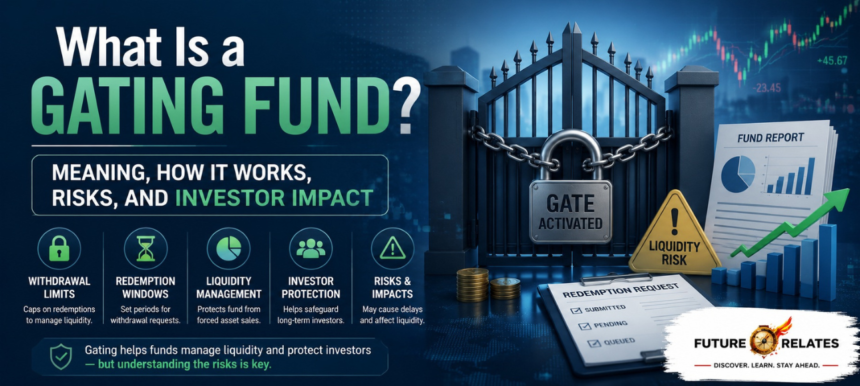

A gating fund is a fund that can slow down or temporarily stop investors from pulling their money out. That sounds dramatic, but it’s usually a defensive move. When too many people ask for their cash at once, and the fund holds assets that can’t be sold quickly, something has to give. The manager hits the brakes.
- What Is a Gating Fund?
- How Does a Gating Fund Work?
- What Is a Gate Provision in a Fund?
- Why Do Funds Gate Withdrawals?
- Which Types of Funds Are Most Likely to Be Gated?
- Gating Fund vs Suspension of Redemptions
- Liquidity Mismatch: The Core Reason Gating Happens
- What Happens to Investors When a Fund Is Gated?
- Real-World Examples of Gated Funds
- Key Documents Investors Should Read Before Investing
- Alternatives Funds Use Instead of Gating
- How to Spot Gating Risk Before You Invest
- Are Gating Funds Good or Bad for Investors?
- FAQs About Gating Fund
- Final Takeaway
Here’s the thing about most funds: they promise regular access to your money, yet they hold things that take time to sell — private loans, office blocks, unlisted companies. That gap between what’s promised and what’s realistic is called liquidity risk. A gating fund uses a “gate” to manage that gap, often by capping withdrawals at a set share of the net asset value (NAV) each quarter or month.
You’ll see gating pop up most in hedge funds, evergreen funds, private credit funds, and real estate funds. Let’s break down how it all works.
What Is a Gating Fund?
A Gating fund is simply a fund with the power to restrict redemptions when withdrawal requests get heavy. It doesn’t mean the fund is failing. It means the rulebook allows a temporary limit to protect everyone still invested.
|
Feature |
What It Means |
|---|---|
|
Core idea |
Limits or pauses investor withdrawals during stress |
|
Common trigger |
Redemption requests exceed available liquid cash |
|
Typical gate level |
5%, 10%, or 20% of NAV per redemption window |
|
Where it appears |
Hedge, evergreen, private credit, real estate funds |
|
Main goal |
Avoid forced selling and protect remaining investors |
|
Investor impact |
Delayed or pro-rated withdrawals |
Simple definition of a gating fund
It’s a fund that reserves the right to say, “Not everyone can cash out right now.” Withdrawals are capped, queued, or deferred until liquidity improves.
What a gate provision means in investing
A gate provision is the clause buried in the fund documents that grants this power. It spells out the cap, the notice period, and how excess requests get handled. No provision, no legal gate.
Why the term matters for modern investors
Semi-liquid private funds have exploded in popularity. Retail investors now access private markets through wrappers that look liquid but aren’t. Knowing what a gating fund is helps you avoid nasty surprises.
How Does a Gating Fund Work?
The mechanics are less scary once you see them laid out.
Redemption windows and withdrawal limits
Many of these funds only let you redeem on set dates — quarterly or monthly. Add a notice period of 30 to 90 days, and the fund knows in advance how much cash it needs. The gate then caps total redemptions, often at up to 5% of NAV per quarter.
How NAV affects gated redemptions
Your payout is based on NAV, the per-share value of the fund’s assets. When assets are hard to price, NAV can lag reality. In extreme stress, a fund may even suspend NAV calculations, which effectively freezes everything.
What happens when requests exceed the gate
Say the gate is 10% and investors ask for 25%. The fund pays everyone a pro-rata slice, then rolls the leftover requests into the next cycle. You wait your turn in the redemption queue.
What Is a Gate Provision in a Fund?
Not all gates are built the same way.
Fund-level gate vs investor-level gate
A fund-level gate caps total withdrawals across everyone. An investor-level gate limits how much each individual can pull in one window. The fund-level version protects the pool; the investor-level one spreads the pain evenly.
Soft gates vs hard gates
A soft gate charges a fee to discourage early exits but still lets you leave. A hard gate simply blocks withdrawals above the cap. One nudges behavior, the other enforces it.
Partial gate vs full suspension
A partial gate lets some money out. A full suspension stops all redemptions cold. Gating is the milder cousin of a total freeze.
Why Do Funds Gate Withdrawals?
To be honest, gating usually happens for sensible reasons — even if it stings.
Managing liquidity risk
When cash reserves and liquid holdings run low, a gate buys the manager time to raise money in an orderly way.
Preventing forced asset sales
Without a gate, a manager might dump assets at fire-sale prices. That distressed selling destroys value for everyone. A gate stops the panic.
Protecting remaining investors during stress
What’s interesting is that gating largely protects the people who stay. It blocks early redeemers from grabbing the best assets and leaving others holding the scraps.
Which Types of Funds Are Most Likely to Be Gated?
Hedge funds
Classic gate users, especially during 2008. Complex or illiquid positions make quick exits impossible.
Evergreen funds
These never-ending structures promise ongoing liquidity while holding private assets. That combination invites gating pressure.
Private credit and private debt funds
Private loans don’t trade on an exchange. When outflows spike — as seen across parts of the private credit fund market — gates and caps come out.
Real estate and commercial property funds
You can’t sell an office block in a day. After the 2016 Brexit vote and again in 2020, several UK property funds gated or suspended.
Open-ended funds with illiquid assets
Any open-ended fund holding hard-to-sell things carries this structural mismatch. That’s the root of the problem.
Gating Fund vs Suspension of Redemptions
Key differences in investor access
A gate limits withdrawals. A suspension halts them entirely. Under a gate, some cash still flows; under a suspension, nothing moves.
When a gate becomes a full freeze
If stress keeps building, a manager may escalate from a partial gate to a full suspension of redemptions. Think of it as the emergency brake after the tap didn’t work.
Why the distinction matters
A gate signals control. A suspension signals crisis. Knowing which one you’re facing tells you a lot about the fund’s health.
Liquidity Mismatch: The Core Reason Gating Happens
Illiquid assets inside liquid or semi-liquid wrappers
This is the heart of it. Fast-access wrappers holding slow-selling assets create a liquidity illusion. It works until everyone heads for the door at once.
Why evergreen structures face pressure
Evergreen funds rely partly on new inflows to fund old outflows. When new money slows and withdrawals rise, the math breaks.
The problem with promising frequent liquidity
Promising monthly or quarterly liquidity on ten-year assets is a stretch. Something eventually snaps, and the gate is how the manager admits it.
What Happens to Investors When a Fund Is Gated?
Delayed withdrawals and pro rata payments
You still own your stake, but you get paid slowly — often a proportional slice now, the rest later.
How investor confidence is affected
A gate shakes trust. Word spreads, more people rush to exit, and pressure builds further. The reputational hit can outlast the gate itself.
Can management fees continue during gating?
Often, yes. Many funds keep charging fees even while your cash is stuck, which understandably frustrates investors.
Real-World Examples of Gated Funds
Michael Burry and The Big Short
Burry, made famous by The Big Short, restricted investor withdrawals in the mid-2000s while betting against the housing market. Investors were furious — until his call paid off.
Woodford Equity Income Fund
Neil Woodford’s fund is the textbook case. Facing outflows reportedly near £60,000 a day, the LF Woodford Equity Income Fund suspended dealing in 2019 and later wound up, leaving many investors recovering well under full value.
Blue Owl and private credit redemption pressure
As private credit boomed, big managers like Blue Owl faced questions about redemption caps on non-traded vehicles when investors wanted out faster than assets could be sold.
Real estate and property fund gating episodes
UK property funds gated repeatedly — after 2016, during the 2020 COVID shock, and around the 2022 mini-budget turmoil.
Key Documents Investors Should Read Before Investing
Prospectus
Read the redemption section closely. It reveals the gate cap and windows.
Offering memorandum
For private funds, this is where the real terms live.
Redemption terms and notice periods
Check how often you can redeem and how long the notice is.
Liquidity policy and side-letter risks
Some big investors get side letters with better exit terms — meaning you might be last in line.
Alternatives Funds Use Instead of Gating
Side pockets
Troubled assets get parked separately so healthy assets keep trading normally.
In specie distributions
Instead of cash, you receive a slice of the actual assets.
Liquidity sleeves
A buffer of cash and short-term instruments kept aside to meet routine withdrawals.
Credit lines and liquid sleeves
Undrawn credit facilities let a fund borrow to pay redemptions without selling assets.
Hybrid fund structures
Some funds blend open and closed features to balance access with stability.
How to Spot Gating Risk Before You Invest
High exposure to illiquid assets
The more unlisted or private holdings, the higher the risk.
Leverage and liquidity stress
Fund-level debt magnifies problems when markets turn.
Weak disclosure or opaque valuations
Vague redemption language and inconsistent marks are red flags.
Heavy redemption dependence on new inflows
If old exits rely on fresh money, that’s fragile by design.
Are Gating Funds Good or Bad for Investors?
The case for gating as protection
A gate prevents fire sales and shields long-term investors. Used well, it’s a safety valve.
The case against gating as a liquidity shock
For someone who needs their money, a gate is a real problem — trapped capital at the worst moment.
When gating may be reasonable
Gating makes sense when the assets are genuinely illiquid and the terms were disclosed upfront. It’s less defensible when the fund oversold easy access.
FAQs About Gating Fund
What is a gating fund in simple terms?
A fund that can limit or pause withdrawals when too many investors want out at once.
How long can a fund stay gated?
It varies — weeks, months, sometimes longer. There’s no fixed limit; it depends on liquidity and fund rules.
Can any fund be gated?
Only if the documents allow it. Most private, evergreen, and open-ended illiquid funds include a gate provision.
Do investors lose money when a fund is gated?
Not automatically. You may face delays, but losses come from asset performance or forced discounts, not the gate itself.
What is the difference between a gate and a side pocket?
A gate limits all redemptions temporarily. A side pocket isolates specific troubled assets while the rest trades normally.
Are ETFs or closed-end funds safer from gating?
Generally, yes. ETFs and closed-ended funds trade on an exchange, so you sell to another buyer instead of the fund — no gate needed.
Final Takeaway
Why understanding liquidity matters more than yield promises
A juicy yield means little if you can’t reach your money when you need it. Liquidity is the quiet detail that decides how a fund behaves under pressure.
What investors should remember before buying semi-liquid private funds
Before you commit, read the redemption terms, understand the gate provision, and ask a simple question: what happens if everyone wants out at once? If a gating fund can lock your cash, make sure you’re comfortable with that trade-off going in. Match your time horizon to the assets — and don’t confuse a liquidity promise with actual liquidity.
For More Information Visit: https://futurerelates.co.uk/