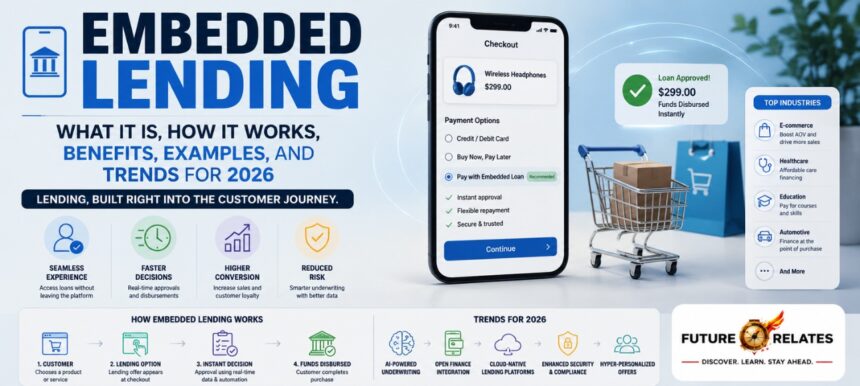

Imagine running an online store and getting a loan offer right inside your dashboard, no bank visit, no stack of paperwork. That’s Embedded lending in action. It’s the practice of building credit and financing directly into apps, marketplaces, and software people already use every day. Instead of sending customers off to a separate lender, the financing shows up at the exact moment they need it.
- What Is Embedded Lending?
- How Does Embedded Lending Work?
- Embedded Lending vs. Embedded Finance
- Embedded Lending vs. Banking-as-a-Service
- Why Embedded Lending Is Growing in 2026
- Key Benefits of Embedded Lending
- Common Embedded Lending Products
- Embedded Lending Examples Across Industries
- What Data Powers Embedded Lending?
- Risks and Challenges of Embedded Lending
- Who Is Using Embedded Lending Today?
- How to Launch an Embedded Lending Program
- The Future of Embedded Lending
- FAQs About Embedded Lending
- Conclusion
Here’s the thing: this matters more than ever in 2026. Businesses want capital fast, and platforms have realized they can offer it without becoming banks themselves. In this guide, you’ll learn how Embedded lending works, who benefits, the products involved, real-world examples, and where the whole space is heading. Let’s get into it.
What Is Embedded Lending?
Embedded lending is a subset of embedded finance. It bakes borrowing options straight into non-financial platforms, so users can access credit without ever leaving the tool they’re using.
|
Element |
Quick Explanation |
|---|---|
|
Definition |
Lending built directly into non-financial platforms and apps |
|
Powered by |
APIs, data integrations, lender-platform partnerships |
|
Serves |
Consumers, SMBs, sellers, freelancers, merchants |
|
Common products |
Working capital, MCA, RBF, BNPL, POS financing |
|
Market outlook |
Embedded finance projected at $7.2 trillion by 2030 |
|
Growth signal |
Roughly 19.6% CAGR across parts of the sector |
Embedded lending definition
In plain terms, embedded lending puts a loan offer inside your workflow. A merchant on an eCommerce platform sees a working capital offer. A shopper at checkout sees a “pay in installments” button. The financing feels native, not bolted on.
Why it is part of the broader embedded finance movement
Embedded finance covers payments, insurance, and banking too. Lending is the credit slice of that pie. What makes it powerful is context: platforms already hold sales and transaction data, so they can make smart, relevant offers at the right time.
How Does Embedded Lending Work?
The magic isn’t really magic. It’s a chain of automated steps happening quietly behind the scenes.
Step 1: Data collection and eligibility checks
The platform already knows a lot about its users, sales history, payment flows, revenue trends. That data feeds an automatic eligibility check. No forms to fill out just to see if you qualify.
Step 2: Pre-approved or contextual loan offers
Based on that data, the user gets a pre-approved or pre-qualified offer. It might appear in a dashboard or pop up at checkout. What’s interesting is how targeted these offers become when they’re built on real behavioral data.
Step 3: Digital application and automated underwriting
The application is short and fully digital. Automated underwriting blends traditional credit signals with alternative data like cash flow and transaction patterns. Decisions that once took days can happen in minutes.
Step 4: Fast disbursement and repayment
Approved funds land quickly, sometimes within one day. Repayment usually aligns with cash flow, a fixed percentage of daily sales, revenue share, or a set schedule. That flexibility is a big reason 89% of borrowers on some platforms come back for repeat financing.
Key idea: embedded lending removes friction at every stage, from offer to payback.
Embedded Lending vs. Embedded Finance
People mix these up constantly, so let’s clear it up.
What embedded finance includes
Embedded finance is the umbrella. It covers embedded payments, embedded insurance, embedded banking, and yes, embedded lending. Think of it as any financial service woven into a non-financial product.
Why embedded lending is a specialized credit use case
Embedded lending focuses only on credit, loans, advances, and financing. It’s the piece that helps businesses grow and shoppers spread out payments. To be honest, it’s often the most valuable slice because credit access drives real economic activity.
Embedded Lending vs. Banking-as-a-Service
These two work together, but they’re not the same thing.
Customer-facing experience vs infrastructure layer
Embedded lending is what the user sees, the offer, the button, the approval. Banking-as-a-Service (BaaS) is the plumbing underneath, the licensed infrastructure that makes the lending legal and functional.
How APIs connect both models
APIs are the glue. A platform plugs into a BaaS provider or infrastructure partner like LoanPro, and suddenly it can originate and service loans without holding a banking license itself.
Why Embedded Lending Is Growing in 2026
Demand for faster access to capital
Small businesses have been starved for affordable funding. Surveys have found that 81% of small business owners struggled to access affordable capital, with many halting expansion as a result. Embedded lending answers that gap directly.
Rise of SaaS, marketplaces, and digital ecosystems
Vertical SaaS tools and marketplaces sit on mountains of customer data. That makes them natural lenders. The more platforms grow, the more embedded credit spreads.
Real-time data and AI-driven underwriting
Real-time data changes everything. AI scoring reads live sales and payment signals, so approvals get faster and more accurate. Better data means fewer bad loans and more people approved.
Key Benefits of Embedded Lending
Benefits for platforms and marketplaces
Platforms gain new revenue, stronger retention, and higher customer lifetime value. Offering credit makes users stick around, some see a 30–50% increase in average ticket size.
Benefits for banks and lenders
Lenders get cheaper distribution, richer borrower data, and scalable origination. Instead of chasing customers, they reach them inside platforms where demand already exists.
Benefits for SMBs and consumers
Borrowers get fast funding, less paperwork, and repayments that match their cash flow. For a shopper, it’s a simple installment plan. For an SMB, it’s working capital that shows up when a slow month hits.
Common Embedded Lending Products
Working capital loans
Short-term funding to cover inventory, payroll, or seasonal dips, often built right into a merchant’s dashboard.
Merchant cash advances
An advance repaid through a slice of future card sales. The merchant cash advance market runs into the tens of billions.
Revenue-based financing
Repayments flex with revenue. Slow week, smaller payment; strong week, larger one.
BNPL and installment financing
Buy now pay later options at checkout. Klarna and Affirm made this model famous with consumers.
Point-of-sale financing and lines of credit
POS financing lets buyers split a purchase at the register or checkout, while revolving lines of credit give ongoing flexibility.
Embedded Lending Examples Across Industries
eCommerce and retail
Shopify Capital offers merchants financing based on their store performance, a textbook embedded lending example.
Vertical SaaS and business software
Accounting, payroll, and booking platforms increasingly offer working capital inside their software.
Healthcare and education
Treatment financing at the clinic and tuition financing at enrollment both fall under this model.
Automotive, hospitality, and home improvement
Financing at the point of purchase helps buyers afford cars, seasonal business needs, and renovation projects.
B2B procurement and marketplace ecosystems
Trade credit and net-terms financing keep supply chains moving. Stripe and Adyen support these flows behind many platforms.
What Data Powers Embedded Lending?
Transaction and payment data
Every sale and settlement tells a story about a borrower’s health.
Sales and revenue performance
Revenue trends show whether a business can comfortably repay.
Operational and behavioral platform data
How often a merchant logs in, fulfills orders, or handles refunds adds context.
Alternative data for better underwriting
Bank activity and cash flow analysis help approve people traditional credit scores would miss, expanding financial inclusion.
Risks and Challenges of Embedded Lending
Compliance and regulatory obligations
Someone must be the lender of record and own responsible lending duties. Rules don’t disappear just because lending is embedded.
Credit risk and overborrowing
Easy access can tempt users to borrow too much. Good affordability checks matter.
Fraud prevention and data privacy
Handling sensitive data means strong security, KYC, and clear disclosures.
Collections, servicing, and portfolio monitoring
The loan lifecycle doesn’t end at disbursement. Servicing, collections, and portfolio health need constant attention.
Who Is Using Embedded Lending Today?
Banks and credit unions
They supply capital and licensing while platforms handle distribution.
Fintechs and infrastructure providers
Companies like LoanPro power loan management and servicing behind the scenes.
Platforms, merchants, and software companies
Marketplaces, eCommerce brands, and SaaS tools embed credit to serve their users and grow revenue.
How to Launch an Embedded Lending Program
Choose the right lending model
Decide between working capital, RBF, BNPL, or POS financing based on your users’ needs.
Build or partner for infrastructure
Most platforms partner rather than build. It’s faster, sometimes live in under three months.
Integrate KYC, underwriting, and servicing
Wire in identity checks, automated underwriting, and repayment processing through APIs.
Create a compliant, scalable customer journey
Design a smooth, transparent flow that keeps regulators and borrowers happy as you grow.
The Future of Embedded Lending
From channel strategy to ecosystem strategy
Lending is shifting from a standalone product to a feature inside every digital ecosystem.
Why embedded lending is becoming lending infrastructure
Credit is turning into a building block, something any platform can plug in like payments.
What 2026 and beyond may look like
Expect more automation, smarter underwriting, and embedded credit reaching underbanked segments worldwide.
FAQs About Embedded Lending
What is embedded lending in simple terms?
It’s credit built into an app or platform, so you borrow without leaving the tool you’re already using.
Is embedded lending the same as BNPL?
No. BNPL is one type of embedded lending. The category also includes working capital, MCA, and lines of credit.
How do repayments work in embedded lending?
Often through automatic deductions, a share of sales, revenue-based payments, or a fixed schedule that fits cash flow.
What types of businesses can offer embedded lending?
Marketplaces, SaaS tools, eCommerce platforms, payment processors, and more, usually through a lending partner.
Is embedded lending regulated?
Yes. A regulated lender of record and proper compliance sit behind every legitimate program.
Conclusion
Embedded lending is quietly reshaping how credit reaches the people and businesses who need it. By meeting borrowers inside the platforms they already trust, it widens access to capital, deepens platform growth, and turns everyday software into a doorway for financing. That’s a real shift, especially for the millions of small businesses long shut out of affordable credit.
Looking ahead, embedded lending will feel less like a feature and more like infrastructure, an invisible layer powering the digital economy. If you run a platform or a growing business, now’s the moment to explore how embedded credit could fit your world. Start by identifying where your users hit funding friction, then find a lending partner who can meet them there.
For More Information Visit: https://futurerelates.co.uk/