
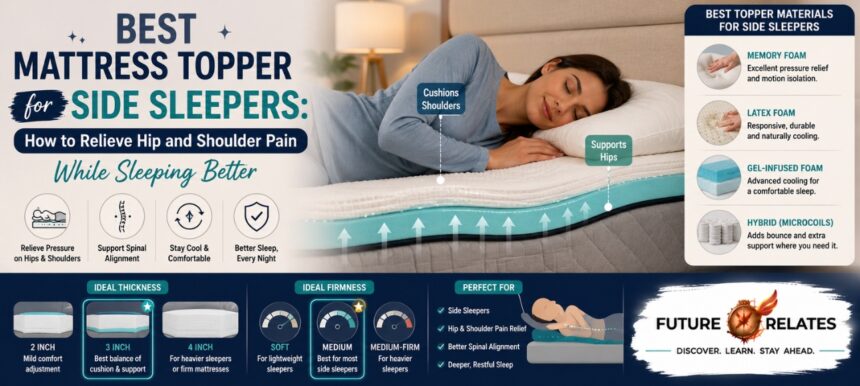

If you sleep on your side, your body carries weight differently than a back or stomach sleeper. Most of your load lands on two spots: your shoulders and your hips. That’s where the aches usually start. Over 60% of adults sleep on their side, and many of them wake up sore without knowing why. The fix isn’t always a new bed. Often, the Best mattress topper for side sleepers solves the problem for a fraction of the cost.
- Why Side Sleepers Need a Different Mattress Topper
- What Makes the Best Mattress Topper for Side Sleepers?
- Best Mattress Topper Materials for Side Sleepers
- How Thick Should a Mattress Topper Be for Side Sleepers?
- What Firmness Is Best for Side Sleepers?
- Best Mattress Topper for Side Sleepers with Hip Pain
- Best Mattress Topper for Side Sleepers with Shoulder Pain
- Best Cooling Mattress Topper for Side Sleepers
- Memory Foam vs Latex for Side Sleepers
- Signs You Need a Mattress Topper Instead of a New Mattress
- How to Choose the Best Mattress Topper for Your Body Weight and Sleep Style
- Important Features to Look For Before You Buy
- Common Mistakes Side Sleepers Make When Buying a Mattress Topper
- Best Mattress Topper for Side Sleepers: Final Buying Advice
- FAQs About Mattress Toppers for Side Sleepers
Here’s the thing. Side sleepers need deep cushioning, but not so much that they sink and lose spinal alignment. That balance between soft and supportive is the whole game. In this guide, I’ll walk you through thickness, firmness, materials, and the small features that actually matter. By the end, you’ll know exactly what to look for.
Why Side Sleepers Need a Different Mattress Topper
Side sleeping puts unusual pressure on a narrow part of your body. Your shoulder and hip stick out further than the rest of you, so they press hard into the mattress. A generic firm surface pushes back, and that’s when pressure points flare up.
|
Sleeper Type |
Main Pressure Zones |
Ideal Feel |
Best Topper Thickness |
|---|---|---|---|
|
Side sleeper |
Shoulders, hips |
Soft to medium-firm |
3 inches |
|
Back sleeper |
Lower back |
Medium-firm |
2 inches |
|
Stomach sleeper |
Chest, hips |
Firm |
1–2 inches |
|
Heavy side sleeper (230+ lbs) |
Shoulders, hips |
Medium-firm |
4 inches |
How side sleeping creates pressure on the hips and shoulders
When you lie on your side, your body weight funnels into two joints. Without enough cushioning, blood flow gets pinched and you feel numbness, tingling, or a dull morning ache. That’s your body telling you the surface is too hard.
Why spinal alignment matters more for side sleepers
A neutral spine means your head, shoulders, hips, and knees form a straight line. If your hips sink too far, your spine curves. If your shoulder can’t sink at all, your neck twists. Good spinal alignment is why a topper that contours matters so much for side sleepers.
Key takeaway: Side sleepers need targeted pressure relief plus enough support to keep the spine neutral.
What Makes the Best Mattress Topper for Side Sleepers?
Not every soft topper is a good topper. The best mattress topper for side sleepers gets four things right.
Pressure relief
The surface should cradle your shoulders and hips so weight spreads evenly. This reduces pressure points and cuts down on tossing and turning.
Support without bottoming out
Contouring is great, but you shouldn’t feel the hard mattress underneath. A quality topper lets you sink in without bottoming out. Density and thickness both play a role here.
Softness vs firmness
Most side sleepers do best in the soft to medium-firm range. Too soft and your hips dip. Too firm and your shoulder can’t settle. It’s a balance, not an extreme.
Temperature regulation for hot sleepers
Soft foam can trap heat. If you sleep hot, look for a breathable, cooling topper with open-cell foam, gel infusion, or a natural fiber cover.
Best Mattress Topper Materials for Side Sleepers
Memory foam mattress toppers
Memory foam is the classic pick. It hugs your body and offers excellent pressure relief and motion isolation. The downside? Basic foam can sleep warm. Look for 3 lb to 5 lb density for lasting support.
Gel-infused memory foam toppers
Same contouring feel, but the gel helps pull heat away. A solid middle-ground choice if you like memory foam but run a little warm.
Latex mattress toppers
Latex feels more buoyant and responsive. Talalay latex is softer and airier; Dunlop is denser and firmer. Latex sleeps cooler than foam and lasts longer, often 5 to 8 years. Look for 19–24 ILD for a plush side-sleeper feel.
Hybrid mattress toppers with microcoils
These blend foam with steel microcoils for zoned support. You get contouring plus a bit of bounce, which many side sleepers love for that “floating” feel.
Wool and down alternative toppers
These add a plush loft rather than deep contouring. They’re breathable and hypoallergenic, but they offer less pressure relief on their own. Good as a secondary comfort layer.
How Thick Should a Mattress Topper Be for Side Sleepers?
2-inch toppers for mild comfort adjustments
A 2-inch topper softens a mattress that’s just slightly too firm. Fine for lighter sleepers who need a small tweak.
3-inch toppers for balanced cushioning and support
Honestly, the 3-inch topper is the sweet spot for most side sleepers. It gives enough cushioning for hips and shoulders while keeping you supported.
4-inch toppers for heavier sleepers and very firm mattresses
Heavier bodies sink further, so a 4-inch topper prevents bottoming out. It’s also great for rescuing a very firm or worn-out bed.
What Firmness Is Best for Side Sleepers?
Soft toppers for lightweight sleepers
Under 130 pounds? A soft topper works well since you won’t sink far. You need the surface to give a little.
Medium to medium-firm toppers for most side sleepers
Between 130 and 230 pounds, medium to medium-firm hits the mark. Enough cushion, enough support.
Firmer toppers for heavier body weights
Over 230 pounds, go medium-firm with higher density. This keeps your hips lifted and your spine straight.
Best Mattress Topper for Side Sleepers with Hip Pain
Why hip pressure builds up
Your hip is a bony point that presses hard into the bed. On a firm surface, that pressure turns into soreness or even bursitis flare-ups.
What features help relieve hip pain
Look for a 3-inch memory foam or Talalay latex topper with a medium-soft feel. It cradles the hip zone so weight redistributes instead of pooling on one joint.
Best Mattress Topper for Side Sleepers with Shoulder Pain
Why the shoulder needs deeper cushioning
Your shoulder needs room to sink in. If it can’t, your neck bends and pressure builds all night.
What materials reduce shoulder pressure
Adaptive memory foam and softer Talalay latex work best. They let the shoulder settle while keeping the rest of your body supported.
Best Cooling Mattress Topper for Side Sleepers
Why side sleepers sleep hot
More of your body contacts the surface when you’re curled up, and soft foam wraps around you, trapping heat.
Cooling features to look for
Choose a cooling topper with open-cell or gel-infused foam, graphite or copper infusion, and a breathable cover in bamboo or cotton. Latex is naturally cooler too.
Memory Foam vs Latex for Side Sleepers
Which one gives better pressure relief
Memory foam wins on deep contouring and pressure relief. It molds to your curves more closely.
Which one sleeps cooler
Latex is the cooler sleeper thanks to its open structure and airflow.
Which one lasts longer
Latex again. It often lasts 5 to 8 years, while foam may soften sooner.
Quick answer: Want a plush hug? Memory foam. Want cool and durable? Latex.
Signs You Need a Mattress Topper Instead of a New Mattress
When a topper is enough
If your mattress is structurally sound but just feels too firm, a topper is a smart, affordable fix.
When your mattress is too old or sagging
If your bed sags or is past 7 to 10 years old, a topper only masks the problem. At that point, replace the mattress.
How to Choose the Best Mattress Topper for Your Body Weight and Sleep Style
Under 130 pounds
Go soft, 2 to 3 inches. You need surface give, not deep density.
130 to 230 pounds
Medium feel, 3 inches. This suits most side sleepers perfectly.
Over 230 pounds
Medium-firm, 4 inches, high density. This keeps you from sinking through.
Important Features to Look For Before You Buy
Removable washable cover
A machine-washable cover keeps things hygienic and fresh.
Corner straps or anti-slip design
Straps or a non-slip base stop the topper from sliding around at night.
Breathable cover materials
Bamboo, cotton, or organic cotton covers help with airflow and cooler sleep.
Trial period and warranty
A generous trial period (often 90 to 180 nights) and a solid warranty of 3 to 10 years show the maker trusts the product.
Common Mistakes Side Sleepers Make When Buying a Mattress Topper
Choosing a topper that is too thin
A 1-inch topper won’t cushion your hips or shoulders enough.
Choosing softness without support
Ultra-soft feels nice at first, then your hips sink and your spine bends.
Ignoring heat retention
If you sleep hot, skip dense basic foam. It’ll bake you.
Using a topper on a sagging mattress
A topper can’t fix a broken base. You’ll still feel the dip.
Best Mattress Topper for Side Sleepers: Final Buying Advice
Best choice for pressure relief
A 3-inch memory foam topper with medium-soft firmness.
Best choice for cooling
Gel-infused foam or Talalay latex with a breathable bamboo cover.
Best choice for natural materials
Organic latex or wool, ideally with GOLS, GOTS, or OEKO-TEX certification.
Best choice for budget shoppers
A quality 3-inch foam topper. Queen options often run $100 to $700, so budget picks exist.
To wrap up, the best mattress topper for side sleepers is usually a 3-inch, soft to medium-firm layer that cushions your hips and shoulders while keeping your spine neutral. Match the thickness and firmness to your body weight, add cooling features if you run warm, and check the trial period before you commit. Get those right, and your mornings will feel a lot kinder.
FAQs About Mattress Toppers for Side Sleepers
What is the best mattress topper for side sleepers?
A 3-inch soft to medium-firm memory foam or latex topper. It delivers pressure relief at the hips and shoulders while keeping your spine aligned.
Is memory foam or latex better for side sleepers?
Memory foam gives deeper contouring and pressure relief. Latex sleeps cooler and lasts longer. Pick based on whether you value a plush hug or coolness and durability.
Can a mattress topper help with shoulder and hip pain?
Yes. A cushioning topper spreads your weight and eases the pressure points that cause hip and shoulder pain, which often reduces morning soreness.
How thick should a mattress topper be for a side sleeper?
Three inches suits most side sleepers. Lighter sleepers can use 2 inches; heavier sleepers often need 4 inches to avoid bottoming out.
Do side sleepers need a soft or medium-firm topper?
Most do best in the soft to medium-firm range. Lighter bodies lean soft, while heavier bodies need medium-firm for proper support.
For More Information Visit: https://futurerelates.co.uk/