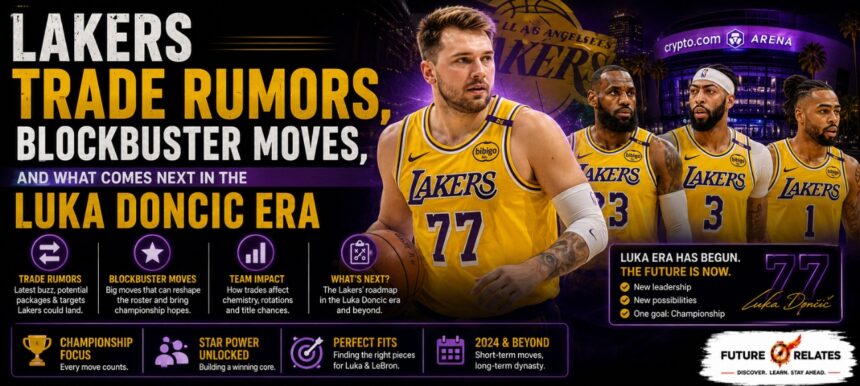

The Lakers have never been a quiet franchise, but the shift from the LeBron James era into the Luka Doncic era took things to a new level. Suddenly, every rumor, every proposed deal, and every trade package became must-watch NBA drama. Anthony Davis got shipped out. Austin Reaves keeps landing in hypothetical frameworks. Even Bronny James and Jarred Vanderbilt get pulled into speculation. Here’s the thing: when you talk about a Lakers trade, you’re really talking about the biggest talking point in the league.
- Why “Lakers Trade” Is One of the Biggest NBA Search Topics
- How the Luka Doncic Trade Changed the Lakers’ Future
- Did the Lakers Win the Luka Doncic Trade?
- Why the Lakers Keep Looking for Another Trade
- Austin Reaves Is the Most Discussed Lakers Trade Chip
- Jarred Vanderbilt, Dalton Knecht, and Moveable Pieces
- Bronny James and Multi-Team Trade Proposals
- Jonathan Kuminga and the Power Forward Obsession
- Salary Cap Rules Driving Trade Rumors
- Lakers’ Best Trade Paths Before Next Deadline
- What the Lakers Must Avoid
- Final Verdict on the Lakers’ Trade Outlook
Let’s break down where things stand, what the Lakers still need, and what might come next.
Why “Lakers Trade” Is One of the Biggest NBA Search Topics
To be honest, no other team generates this kind of noise. A single Lakers trade rumor can dominate a news cycle for days.
| Topic | Quick Answer |
|---|---|
| Biggest recent trade | Anthony Davis for Luka Doncic |
| Most discussed trade chip | Austin Reaves |
| Top roster needs | Rim protection, 3-and-D wings, power forward |
| Frequent target | Jonathan Kuminga |
| Key limits | Hard cap, first apron, salary matching |
| Draft capital | Limited firsts, several second-round picks |
Lakers’ blockbuster history
The franchise built its brand on splash moves. Shaq. Pau Gasol. Then the Anthony Davis deal that delivered a title. Los Angeles doesn’t rebuild slowly; it swings big. That reputation makes any Lakers trade feel plausible, no matter how wild the framework.
Why LA rumors go viral
Location matters. This is Hollywood, a global market, and a fanbase that spans continents. Add star power and national TV games, and every whisper gets amplified. What’s interesting is how a small report from an insider can snowball into a full-blown trade narrative within hours.
How the Luka Doncic Trade Changed the Lakers’ Future
The Luka Doncic trade rewired everything. It wasn’t just a roster move; it reset the timeline.
Why the Anthony Davis swap shocked the NBA
Why did the Lakers trade Anthony Davis for Luka Doncic? Simple, they landed a 25-year-old, five-time All-NBA guard entering his prime. Still, it stunned everyone. Trading a two-way big like Davis, a proven champion, for a franchise cornerstone felt like an all-time NBA shocker. Nobody saw Nico Harrison in Dallas actually pulling the trigger. Rob Pelinka, on the other side, walked away with a foundational piece.
What building around Luka means
Building around Luka changes the checklist. He’s a ball-dominant on-ball creator who racks up numbers like 28.1 points, 8.3 rebounds, and 7.8 assists. That means the Lakers need shooters, rim runners, and defenders who thrive off the ball. The post-LeBron future now runs through Luka’s shot creation, so roster fit around him became the front office’s main focus.
Did the Lakers Win the Luka Doncic Trade?
Did the Lakers win the Luka Doncic trade? Most fans say yes, but it’s fair to look at both sides.
The case for LA
Los Angeles got the younger superstar with a longer title window. Luka can carry an offense for a decade. That’s the kind of asset you rarely pry loose. For a win-now team also thinking about future planning, that’s a rare double win.
The case for Dallas
Dallas got a defensive anchor and rim protector in Davis, plus salary flexibility. On paper, Nico Harrison wanted a rugged two-way big to reshape the roster. Injuries and fan backlash complicated the story, but the logic wasn’t zero. Still, the reaction leaned heavily toward LA as the winner.
Why the Lakers Keep Looking for Another Trade
Landing Luka didn’t end the shopping. If anything, it sharpened what the Lakers must chase.
Rim protection
This is the loudest need. Without a true defensive anchor, the Lakers give up too much at the rim. A center like Walker Kessler, who eats up shots inside, keeps surfacing in trade ideas for exactly this reason.
3-and-D wings and shooting
Luka needs floor spacing. A switchable 3-and-D wing who can hit catch-and-shoot threes and guard multiple positions is gold next to him. The Lakers keep hunting for perimeter shooting and perimeter defense to balance the roster.
The power forward problem
There’s a lingering hole at starting power forward. The Lakers want two-way impact there, someone who can defend, space the floor, and finish lobs. That gap is a big reason names like Jonathan Kuminga and P.J. Washington keep popping up.
Austin Reaves Is the Most Discussed Lakers Trade Chip
Will the Lakers trade Austin Reaves? Only under one very specific condition.
Why the Lakers value him
Reaves is a bargain relative to his production, a secondary playmaker who scores, passes, and fits nicely beside Luka. He gives the Lakers cheap, quality shot creation. That combination of value and fit makes him their most prized non-star asset.
One condition for trading Reaves
Here’s the thing: the Lakers won’t move Reaves for role players. The one condition is a genuine star coming back. He’s the centerpiece any superstar deal would require, so unless a top-tier name becomes available, expect him to stay put.
Jarred Vanderbilt, Dalton Knecht, and Moveable Pieces
Not every asset is protected. Some names exist mainly to make the salary math work.
Vanderbilt in trade ideas
Are the Lakers shopping Jarred Vanderbilt? Sort of. He’s a defensive-minded forward whose contract fits into salary matching. That’s why he shows up as a supporting piece in so many proposed deals, alongside movable young players like Dalton Knecht and Jake LaRavia.
Roster crunch and trade value
Roster crunch is real. When you’ve got more guaranteed contracts than useful minutes, guys like Maxi Kleber, Gabe Vincent, and Rui Hachimura become trade filler or salary ballast. Their value isn’t always on the court; sometimes it’s in the math.
Bronny James and Multi-Team Trade Proposals
Could the Lakers trade Bronny James? In theory, yes, and fans love to imagine it.
Why Bronny appears in hypothetical deals
Bronny lands in speculative 3-team and 4-team frameworks because a young, cheap contract helps balance complex deals. His name adds intrigue, so writers plug him into hypothetical packages that need a small salary to complete the puzzle.
Realistic return
To be honest, Bronny alone won’t fetch much. His real trade value is as a minor piece inside a bigger structure. Any realistic return would come from the overall package, not from him specifically.
Jonathan Kuminga and the Power Forward Obsession
Who are the Lakers’ top trade targets? Jonathan Kuminga sits near the top of the wish list.
Why Kuminga is a Lakers target
Kuminga is a young, athletic forward with real upside, a possible answer at power forward. He brings frontcourt help and explosive finishing, exactly the two-way profile the Lakers crave next to Luka.
Sign-and-trade hurdles
A sign-and-trade sounds clean but isn’t. Base Year Compensation, the hard cap, and matching salaries all complicate it. Under the current CBA, a sign-and-trade can trigger a hard cap at the first apron, which limits what else the Lakers can do. That’s why these moves stall.
Salary Cap Rules Driving Trade Rumors
What quietly shapes every Lakers trade? The rules.
Hard cap, first apron, salary matching
The first apron acts like a ceiling. Cross it through certain moves, and you get hard-capped, which kills flexibility. Salary matching means outgoing and incoming money must roughly line up. These CBA restrictions decide which deals are even legal.
Why draft capital matters
How much draft capital do the Lakers have? Not a ton. They own a limited number of tradable firsts plus a handful of second-round picks and pick swaps stretching toward 2031 and 2032. With a thin war chest, every unprotected first-round pick they hold becomes precious ammunition.
Lakers’ Best Trade Paths Before Next Deadline
Can the Lakers still make another blockbuster trade? Yes, and here are three realistic lanes.
Star swing
Package Reaves, salary filler, and draft capital for a second star beside Luka. High risk, high reward.
Depth upgrade
Trade role players and a second-rounder for a reliable rim protector or a sharpshooter. Less flashy, but it fixes real needs.
Low-risk bargain
Chase an expiring contract or a buy-low wing. Cheap, flexible, and it keeps future options open.
What the Lakers Must Avoid
Not every big move is a smart one.
Overpaying picks
Draining their limited draft capital for a marginal upgrade would leave them stuck later. Restraint matters.
Sacrificing fit
Star power means little if the pieces clash. A shiny name who doesn’t fit around Luka’s game isn’t worth the roster fit tradeoff.
Repeating past mistakes
The Russell Westbrook and D’Angelo Russell experiments taught hard lessons. Chasing names over function backfired before. Rob Pelinka can’t afford a repeat.
Final Verdict on the Lakers’ Trade Outlook
Closer to another blockbuster?
The Lakers are always one move from a headline. With Luka locked in and clear needs at center and forward, another big Lakers trade feels like a matter of when, not if.
What fans should expect
Expect nonstop chatter, a few near-misses, and at least one meaningful deal before the deadline. Keep an eye on the cap sheet and the draft capital, because those two things will decide what’s actually possible.
For More Information Visit: https://futurerelates.co.uk/