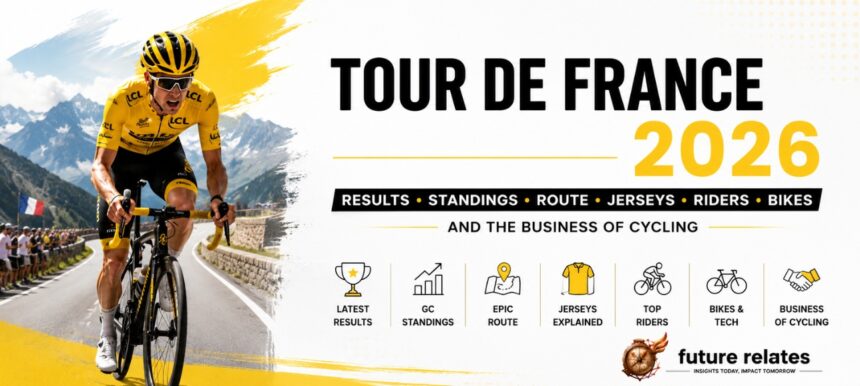

From Tadej Pogacar’s Stage 3 win and yellow jersey charge to heatwave conditions, iconic climbs, team tactics, race history, bike tech and cycling economics, here’s everything you need to know about the Tour de France.
- What Is the Tour de France?
- Tour de France 2026 at a Glance
- Tadej Pogacar Wins Stage 3 and Takes Yellow
- Tour de France 2026 Standings and Results
- Jersey Standings Explained
- Tour de France Riders Brace for Scorching Heat
- Stage 4 Preview: Carcassonne to Foix
- Tour de France 2025 Route and Iconic Climbs
- How the Tour de France Works
- The Riders to Watch
- The Tour de France Bikes, Ranked by Technology and Style
- The Business of Cycling Behind the Tour de France
- Tour de France History, Records and Legendary Winners
- Why the Tour de France Still Captivates the World
- Final Takeaway
- FAQs
The Tour de France is back, and honestly, it never disappoints. Every July, the world’s best cyclists throw themselves at brutal mountains, blazing heat, and lightning-fast sprints for three exhausting weeks. This year feels especially electric. So grab a coffee, settle in, and let’s break down everything happening in the 2026 race.
What Is the Tour de France?
Why the Tour de France is the biggest race in cycling
Here’s the thing — the Tour de France isn’t just a bike race. It’s a moving festival, a sporting drama, and a national celebration all rolled into one. Roughly 176 riders across 20 to 23 teams battle over 21 stages and around 3,500 kilometres (about 2,200 miles) of French roads. Fans line the mountains for hours just to see the peloton whoosh by in seconds.
How the Tour became the most prestigious Grand Tour
It all started way back in 1903, dreamed up by Henri Desgrange and journalist Géo Lefèvre to boost newspaper sales. Wild, right? Over a century later, it stands as the crown jewel of the three Grand Tours. Winning the maillot jaune (the famous yellow jersey) is the single biggest prize in professional road cycling.
Tour de France 2026 at a Glance
Dates, format, number of stages and key facts
The 2026 edition keeps the classic recipe: 21 stages spread across roughly 23 days, with flat sprints, punchy hilly stages, individual time trials, and those lung-busting mountain climbs. Eight riders make up each squad, and the final showdown traditionally ends on the Champs-Élysées in Paris.
|
Feature |
Detail |
|---|---|
|
Total stages |
21 |
|
Total distance |
~3,500 km (2,200 miles) |
|
Riders at start |
176 |
|
Riders per team |
8 |
|
Teams |
20 to 23 |
|
Race duration |
~23 days |
|
Grand finish |
Champs-Élysées, Paris |
|
Current yellow jersey |
Tadej Pogacar |
|
First edition |
1903 |
Why the 2026 edition is drawing global attention
To be honest, a lot of eyes are on Tadej Pogacar chasing more history. Add a brutal heatwave, a fresh crop of young talent, and the ever-present rivalry with Jonas Vingegaard, and you’ve got a race people can’t stop watching.
Tadej Pogacar Wins Stage 3 and Takes Yellow
How Pogacar surged late to win
Stage 3 was pure Pogacar. On a punchy category three finish, he waited, waited, then unleashed a blistering late acceleration that nobody could answer. His UAE Team Emirates-XRG crew set him up perfectly, and he snatched the stage win plus the yellow jersey in one move.
What the Stage 3 result means for the GC battle
What’s interesting is how early Pogacar grabbed the overall lead. Those precious bonus seconds already give him breathing room over the general classification contenders. It’s a statement — the defending-style champion isn’t waiting for the Pyrenees to make his mark.
Tour de France 2026 Standings and Results
General classification after Stage 3
Pogacar leads the GC after his surge, with the chasing pack scrambling to limit their losses. Riders like Vingegaard, Remco Evenepoel, and Isaac del Toro sit within striking distance — we’re talking gaps of just seconds, from 2 seconds up to around 53 seconds among the top favorites.
Stage 3 top finishers and time gaps
The finish was tight. Small time gaps of 4 seconds, 23 seconds, and 27 seconds shuffled the standings behind the leader. Cumulative time is everything here, so even a two-second slip can haunt a GC hopeful weeks later.
Jersey Standings Explained
Yellow jersey, green jersey, polka dot jersey and white jersey
Four jerseys, four different battles:
- Yellow jersey (maillot jaune): overall race leader by cumulative time
- Green jersey: the points classification, usually a sprinters’ fight
- Polka dot jersey: King of the Mountains, for the best climber
- White jersey: best young rider under 26
Which riders lead each classification right now
Pogacar holds yellow. The green jersey typically swings toward the fastest sprinters, while ambitious climbers chase the polka dots. The white jersey is one to watch, with fresh names like Paul Seixas and Florian Lipowitz turning heads.
Tour de France Riders Brace for Scorching Heat
How the heatwave is affecting riders and teams
The sweltering conditions this year are no joke. Temperatures have crept toward 41 degrees Celsius (about 106 Fahrenheit) on some stages. That kind of extreme heat drains riders fast and even raises wildfire concerns near the route.
Cooling strategies, UCI protocols and safety concerns
Teams are fighting back with ice vests, cold bottles, and packed feed zones. The UCI monitors the Wet Bulb Globe Temperature and can trigger its heatwave protocol to protect rider safety. Smart hydration and cooling can genuinely decide who cracks on the final climb.
Stage 4 Preview: Carcassonne to Foix
Distance, terrain and race profile
Next up, the peloton rolls from the medieval city of Carcassonne toward Foix on the edge of the Pyrenees. Expect a hilly, tactical stage with lumpy terrain that rewards brave breakaway efforts.
Which riders could thrive on the next stage
This one suits punchy all-rounders and breakaway specialists. If a domestique-supported move sticks, we could see a surprise winner. But don’t rule out Pogacar sniffing out more bonus seconds.
Tour de France 2025 Route and Iconic Climbs
Key mountain stages in the Pyrenees and Alps
The route weaves through the Pyrenees and Alps, stacking up jaw-dropping vertical gain — often over 170,000 feet across the whole race. These summit finishes are where the Tour is truly won or lost.
Mont Ventoux, Hautacam, Tourmalet and Col de la Loze
Legendary names dot the map: the barren moonscape of Mont Ventoux, the punishing Hautacam, the mighty Col du Tourmalet, and the sky-high Col de la Loze near Courchevel. La Plagne and Peyragudes add even more suffering. Beautiful, brutal, unforgettable.
How the Tour de France Works
How general classification is calculated
Simple idea, ruthless execution: your times across every stage add up, and the lowest cumulative time wins. That’s the general classification, and it’s why time trials matter so much.
How stage wins, bonus seconds and team tactics shape the race
Stage wins bring glory, but bonus seconds at finishes and intermediate points can flip the GC. Then there’s the chess match — domestiques shelter their leader, control the peloton, and launch attacks at the perfect moment.
The Riders to Watch
Pogacar, Vingegaard, Evenepoel, Del Toro and Ayuso
Pogacar is the clear favorite, with Jonas Vingegaard of Visma-Lease a Bike his biggest threat. Remco Evenepoel brings time-trial firepower, while Isaac del Toro and Juan Ayuso represent the exciting next wave.
Climbers, sprinters, all-rounders and young contenders
You’ve also got sprint legends like Mark Cavendish, versatile stars like Wout van Aert, and rising talents like Paul Seixas. It’s a beautiful mix of climbers, sprinters, and all-rounders.
The Tour de France Bikes, Ranked by Technology and Style
Aero bikes, climbing bikes and time trial machines
Modern race bikes are engineering marvels. Aero bikes cut through the wind, feather-light climbing bikes float uphill, and time trial machines are built purely for speed. All feature carbon-fiber frames, disc brakes, and slick integrated cockpits.
Colnago, Specialized, Bianchi, Pinarello, Wilier and more
The peloton is a rolling showroom — Colnago, Specialized, Pinarello, the iconic Bianchi, Wilier, plus Trek, Canyon, and Cervélo. Pogacar’s Colnago is arguably the most talked-about bike in the bunch.
The Business of Cycling Behind the Tour de France
ASO, UCI, sponsorships and media rights
Behind the drama sits big business. Amaury Sport Organisation (ASO) runs the Tour, while the UCI governs the sport. Media rights, sponsorships, and host city fees generate serious revenue.
Why team budgets and economics matter in pro cycling
Team budgets swing wildly — anywhere from roughly 10 to 40 million dollars a year. Prize money helps too, with the overall winner banking around 500,000 euros and stage day payouts flowing to the squads. Sponsorship keeps the wheels turning, literally.
Tour de France History, Records and Legendary Winners
Most Tour wins, most stage wins and yellow jersey milestones
Five riders share the record of 5 overall wins. Eddy Merckx and Mark Cavendish battled for the most stage wins, and Merckx famously spent 96 days in yellow. These numbers are the stuff of cycling mythology.
From Maurice Garin to Eddy Merckx to Tadej Pogacar
The story runs from Maurice Garin winning that first 1903 edition, through icons like Jacques Anquetil, Bernard Hinault, and Miguel Indurain, right up to today’s superstar Pogacar. Different eras, same relentless suffering.
Why the Tour de France Still Captivates the World
Sporting drama, cultural heritage and global audience
Millions tune in worldwide, and millions more line the roads for free. There’s nothing quite like it — sport, scenery, and heritage colliding for three weeks.
What makes the Tour unique in modern sport
Where else can you watch elite athletes race past castles, vineyards, and snow-capped peaks, all for no admission fee? That mix of accessibility and grandeur makes the Tour genuinely one of a kind.
Final Takeaway
What defines the current Tour narrative
Right now, it’s all about Pogacar in yellow, a fierce GC fight, and riders battling scorching conditions. The story is far from written.
What to expect in the stages ahead
The Pyrenees and Alps loom large. Expect fireworks on the summit finishes, more heatwave drama, and a nail-biting fight for every jersey. Buckle up — the best is yet to come!
FAQs
What is the Tour de France?
It’s the world’s most famous multi-stage road cycling race, held annually in France over 21 stages and roughly 3,500 kilometres.
Who won Stage 3 of the 2026 Tour de France?
Tadej Pogacar won Stage 3 with a late surge and took the yellow jersey.
Who has the yellow jersey in the Tour de France 2026?
Tadej Pogacar currently leads the general classification and wears the maillot jaune.
How many stages are in the Tour de France?
There are 21 stages, spread across about 23 days.
How does the general classification work?
Every rider’s stage times are added together, and the lowest cumulative time wins the race.
What do the yellow, green, polka dot and white jerseys mean?
Yellow is the race leader, green is the points (sprint) leader, polka dot is the best climber, and white is the best young rider under 26.
Why are Tour de France riders dealing with extreme heat?
A severe heatwave has pushed temperatures near 41°C, triggering UCI heat protocols and extra cooling measures.
What is the route for the Tour de France 2025?
It features flat, hilly and mountain stages through the Pyrenees and Alps, including climbs like Mont Ventoux, Hautacam, and Col de la Loze.
Which riders are favorites to win the Tour de France?
Tadej Pogacar and Jonas Vingegaard lead the pack, with Remco Evenepoel, Isaac del Toro, and Juan Ayuso in the mix.
What bikes are used in the Tour de France?
Riders use high-tech carbon-fiber bikes from brands like Colnago, Specialized, Pinarello, Bianchi, and Wilier.
Who organizes the Tour de France?
Amaury Sport Organisation (ASO) organizes the race, while the UCI governs the sport overall.
Why is the Tour de France important in cycling?
It’s the most prestigious race in the sport, carrying the richest history, biggest audience, and greatest honor a rider can earn.
For More Information Visit: https://futurerelates.co.uk/