

Here’s the thing about biology class — the plant cell diagram is one of those topics you just can’t skip. It shows up in exams, homework sheets, and school projects again and again. And to be honest, once you understand it, everything about how plants live and grow starts to make sense. In this guide, we’ll walk through a labeled plant cell diagram, break down each part, and explain what it does. Simple, clear, and easy to follow. You can also explore more educational and informational content on FutureRelates.
- What Is a Plant Cell?
- Plant Cell Diagram Overview
- Parts of a Plant Cell Diagram
- Plant Cell Organelles and Their Functions
- Plant Cell Wall Structure
- Why Chloroplasts Are Important in a Plant Cell
- Central Vacuole and Turgor Pressure
- Plant Cell vs Animal Cell
- How to Draw a Neat Labelled Diagram of Plant Cell
- Types of Plant Cells
- Plant Cell Diagram for Students, Exams, and Worksheets
- FAQs About Plant Cell Diagram
- Key Takeaways
What Is a Plant Cell?
A plant cell is the tiny building block that makes up every plant on Earth. From a blade of grass to a towering tree, it all starts here.
Plant cell definition
A plant cell is the smallest living unit of a plant. It has a rigid outer wall, a jelly-like inside, and many little structures called organelles. Most plant cells measure between 0.1 and 100 micrometers, so they’re far too small to see without a microscope.
Why plant cells are called eukaryotic cells
What’s interesting is that plant cells are eukaryotic. That means they have a true nucleus wrapped in a membrane, plus other membrane-bound organelles. This sets them apart from simpler cells like bacteria, which don’t have a packaged nucleus.
| Feature | Plant Cell |
|---|---|
| Type | Eukaryotic |
| Size | 0.1–100 micrometers |
| Nucleus | Membrane-bound |
| Outer layer | Rigid cell wall |
Plant Cell Diagram Overview
A good diagram turns a complex cell into something you can actually picture. That’s why the plant cell diagram is such a handy study tool.
What a labeled plant cell diagram shows
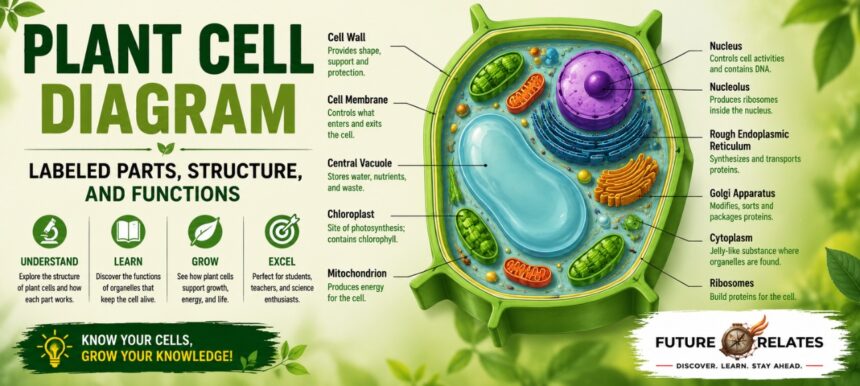
A labeled plant cell diagram points out each part with clear callout lines. You’ll spot the cell wall, cell membrane, nucleus, chloroplasts, vacuole, mitochondria, ribosomes, ER, and the Golgi apparatus. Each label helps you connect the name to its shape and spot.
How to read a plant cell diagram correctly
Start from the outside and work your way in. Notice the tough cell wall first, then the membrane just beneath it. After that, look inside for the nucleus and the big central vacuole. Reading a plant cell diagram this way keeps things organized and easy to remember!
| Diagram Type | Best Use |
|---|---|
| Labeled | Learning parts |
| Blank | Testing recall |
| Printable | Revision and projects |
Parts of a Plant Cell Diagram
Now let’s get into the good stuff. Every part of a plant cell diagram plays a role, and here they are one by one.
Cell wall
The cell wall is the rigid outer layer. It protects the cell and gives it a firm, boxy shape.
Cell membrane
Sitting just inside the wall, the cell membrane is semi-permeable. It controls what goes in and out of the cell.
Cytoplasm
The cytoplasm is the jelly-like fluid that fills the cell. All the organelles float around inside it.
Nucleus
The nucleus is the control center. It holds the DNA and directs cell activities like growth and division.
Chloroplasts
Chloroplasts are the green organelles where photosynthesis happens. They give plants their color and their food.
Large central vacuole
This big, fluid-filled sac stores water and nutrients. In mature plant cells, it can take up as much as 90% of the cell’s volume!
Mitochondria
Mitochondria are the powerhouses. They break down sugars to release energy the cell can use.
Ribosomes
Ribosomes are tiny factories that build proteins. Some float freely; others sit on the ER.
Golgi apparatus
The Golgi apparatus packages and sorts proteins. Think of it as the cell’s shipping department.
Endoplasmic reticulum
The endoplasmic reticulum, or ER, is a network of tubes. The rough ER makes proteins; the smooth ER handles lipids.
| Part | Main Job |
|---|---|
| Cell wall | Support and protection |
| Membrane | Controls entry/exit |
| Nucleus | Stores DNA, controls cell |
| Chloroplast | Photosynthesis |
| Vacuole | Storage, turgor |
| Mitochondria | Energy release |
Plant Cell Organelles and Their Functions
Each organelle has a clear purpose. Let’s group them by what they do.
Organelles involved in photosynthesis
Chloroplasts lead the way here. They capture sunlight and turn carbon dioxide and water into glucose and oxygen.
Organelles involved in storage and support
The central vacuole stores water, sugars, and salts. The cell wall backs it up by keeping the cell firm and strong.
Organelles involved in protein synthesis and transport
Ribosomes make proteins, the ER moves them along, and the Golgi apparatus packs them for delivery. It’s a smooth little assembly line!
| Function | Organelle |
|---|---|
| Photosynthesis | Chloroplast |
| Storage | Vacuole |
| Protein building | Ribosomes |
| Transport | ER, Golgi |
Plant Cell Wall Structure
The cell wall isn’t just one solid layer. It’s actually built in three layers, and each one matters.
Primary cell wall
This is the first, flexible layer formed as the cell grows. It’s thin and stretchy.
Secondary cell wall
Some cells add a thicker, tougher secondary wall for extra strength.
Middle lamella
The middle lamella is the sticky layer that glues neighboring cells together.
Cellulose, hemicellulose, pectin, and lignin
What holds it all together? Cellulose gives strength, hemicellulose and pectin add flexibility and bonding, and lignin makes certain walls stiff and woody.
| Layer | Feature |
|---|---|
| Primary wall | Thin, flexible |
| Secondary wall | Thick, strong |
| Middle lamella | Cell-to-cell glue |
Why Chloroplasts Are Important in a Plant Cell
Chloroplasts are the reason plants can feed themselves. Without them, no green world!
Role of chlorophyll
Chlorophyll is the green pigment inside chloroplasts. It absorbs sunlight to power photosynthesis.
Where photosynthesis happens
Photosynthesis takes place right inside the chloroplasts. That’s where light energy becomes food energy.
Grana, stroma, and thylakoids explained
Inside a chloroplast, thylakoids are stacked into piles called grana. The stroma is the fluid around them. Together they team up to make glucose.
| Part | Role |
|---|---|
| Chlorophyll | Absorbs sunlight |
| Thylakoids | Light reactions |
| Stroma | Sugar production |
Central Vacuole and Turgor Pressure
The central vacuole is a big deal — literally. It’s often the largest structure in the cell.
What the vacuole stores
It holds water, nutrients, sugars, salts, and waste. It’s the cell’s storage tank.
How turgor pressure supports the plant
When the vacuole fills with water, it pushes against the wall. This turgor pressure keeps plants firm and upright. Lose that water, and the plant wilts.
What tonoplast and cell sap do
The tonoplast is the membrane around the vacuole. The cell sap is the fluid inside it, packed with dissolved substances.
| Term | Meaning |
|---|---|
| Vacuole | Storage sac |
| Tonoplast | Vacuole membrane |
| Cell sap | Inner fluid |
| Turgor | Water pressure support |
Plant Cell vs Animal Cell
People often mix these two up. Let’s clear it up fast.
Major differences in structure
Plant cells have a rigid wall and a fixed shape. Animal cells are softer and more irregular.
Organelles found only in plant cells
Only plant cells have a cell wall, chloroplasts, and a large central vacuole. Animal cells skip all three.
Why plant cells are more rigid and rectangular
That tough cellulose wall gives plant cells their boxy, rectangular look. Animal cells stay round and flexible.
| Feature | Plant Cell | Animal Cell |
|---|---|---|
| Cell wall | Yes | No |
| Chloroplasts | Yes | No |
| Vacuole | Large | Small |
| Shape | Rectangular | Irregular |
How to Draw a Neat Labelled Diagram of Plant Cell
Drawing a plant cell diagram is easier than it looks. Follow these steps and you’ll nail it!
Step-by-step drawing process
Start with a large rectangle for the wall. Add a thin line inside for the membrane. Draw a round nucleus, a big vacuole, several oval chloroplasts, and a few smaller organelles. Add neat callout lines.
Labels you must include
Always label the cell wall, membrane, cytoplasm, nucleus, chloroplasts, vacuole, mitochondria, ribosomes, ER, and Golgi apparatus.
Common mistakes students make
Don’t forget the cell wall — that’s the classic slip. Also, keep your labels straight and avoid crossing your callout lines.
| Do | Don’t |
|---|---|
| Use a ruler for the wall | Skip the cell wall |
| Label clearly | Cross label lines |
| Keep it neat | Overcrowd organelles |
Types of Plant Cells
Not all plant cells are the same. Different jobs call for different types.
Parenchyma cells
These are the all-rounders. They store food and help with photosynthesis.
Collenchyma cells
These give flexible support, especially in growing stems and leaves.
Sclerenchyma cells
Tough and rigid, these cells provide strong structural support. Their walls are thick with lignin.
Xylem and phloem cells
Xylem cells move water up from the roots. Phloem cells carry food made in the leaves to the rest of the plant.
| Cell Type | Main Role |
|---|---|
| Parenchyma | Storage, photosynthesis |
| Collenchyma | Flexible support |
| Sclerenchyma | Rigid support |
| Xylem/Phloem | Transport |
Plant Cell Diagram for Students, Exams, and Worksheets
A plant cell diagram is a student’s best friend during revision. Here’s how to use it well.
Labeled diagrams
Labeled versions help you learn each part and its function quickly.
Blank plant cell diagrams
A blank plant cell diagram is perfect for testing yourself. Fill in the labels from memory!
Printable worksheets and revision use
Printable worksheets and labeling activities make exam prep simple and even a little fun.
| Resource | Best For |
|---|---|
| Labeled diagram | First learning |
| Blank diagram | Self-testing |
| Worksheet PDF | Revision |
FAQs About Plant Cell Diagram
What are the main parts of a plant cell?
The main parts are the cell wall, membrane, cytoplasm, nucleus, chloroplasts, vacuole, mitochondria, ribosomes, ER, and Golgi apparatus.
What is the function of the cell wall?
The cell wall protects the cell, gives it shape, and provides strong structural support.
Why do plant cells have chloroplasts?
Chloroplasts hold chlorophyll and carry out photosynthesis, letting plants make their own food.
What is the difference between plant cell and animal cell?
Plant cells have a cell wall, chloroplasts, and a large vacuole. Animal cells have none of these.
How much of the plant cell is occupied by the vacuole?
In mature plant cells, the central vacuole can fill up to 90% of the cell’s volume.
Key Takeaways
Quick summary of structure
Plant cells are eukaryotic. They have a three-layered cell wall, a membrane, a nucleus, chloroplasts, and a large central vacuole.
Quick summary of functions
The wall supports, chloroplasts feed, the vacuole stores, and mitochondria power the cell.
Quick exam revision points
Remember: cell walls have cellulose, chloroplasts run photosynthesis, and the vacuole can reach 90% of the cell. Learn the plant cell diagram well, and you’ll be ready for any exam question.
For additional authoritative background on plant cells and their structure, see Encyclopaedia Britannica — Plant Cell and Wikipedia — Plant Cell.
For More Information Visit: https://futurerelates.