
A beginner-friendly guide to making cannabis oil safely, choosing the right carrier oil, and dosing homemade weed oil with confidence.
- What Is Weed Oil?
- Why People Make Cannabis Oil at Home
- Best Carrier Oils for Homemade Weed Oil
- Why Decarboxylation Is the Most Important Step
- How to Decarb Cannabis for Oil
- Ingredients and Tools You Need to Make Weed Oil
- Weed Oil Recipe: Step-by-Step Instructions
- Best Temperature and Time for Cannabis Oil Infusion
- How to Strain and Store Homemade Cannabis Oil
- How to Dose Homemade Weed Oil
- How to Use Cannabis Oil
- Cannabis Oil vs CBD Oil: What’s the Difference?
- Cannabis Oil vs Cannabutter
- Common Mistakes to Avoid When Making Weed Oil
- Is Hash Oil the Same as Weed Oil?
- Can You Make Weed Oil for Vape Pens?
- FAQ About Making Weed Oil
- Final Thoughts on Making Weed Oil at Home
So you want to figure out Weed oil how to make it at home, without guessing your way through the process. Good news: it’s easier than you’d think! Homemade weed oil is warm, versatile, and honestly kind of fun to make. You control the potency, the flavor, and every single ingredient that goes into it. Let’s walk through it together, start to finish.
What Is Weed Oil?
Weed oil is a cooking oil that’s been infused with the active compounds from cannabis. Think of it as a flavored oil with a purpose. You take a good carrier oil, add decarbed flower, and let the two sit together low and slow until the cannabinoids move into the fat. That’s the whole magic trick, really.
|
Quick Facts |
Details |
|---|---|
|
What it is |
Carrier oil infused with cannabis compounds |
|
Best carrier oils |
Coconut, olive, avocado, canola |
|
Decarb temp/time |
220–245°F for 30–40 minutes |
|
Infusion temp/time |
160–200°F for 2–6 hours |
|
Beginner ratio |
1 cup oil to 7 grams cannabis |
|
Storage |
Airtight glass jar, cool dark place |
|
Shelf life |
Up to 12–18 months |
|
Starter dose |
2.5–5 mg THC |
Weed oil vs cannabis oil vs canna oil
Here’s the thing: these three names mean pretty much the same thing. Weed oil, cannabis oil, and canna oil are all casual terms for cannabis-infused cooking oil. Don’t let the different labels confuse you.
How cannabis-infused oil works
The heat gently pulls cannabinoids like THC and CBD out of the plant and binds them to the oil. Simple, steady, and reliable.
Why cannabinoids need fat to bind
Cannabinoids are fat-soluble. That means they cling to fats and oils, not water. This is exactly why oil works so well as an infusion base.
Why People Make Cannabis Oil at Home
To be honest, once folks try making their own, they rarely go back to store shelves.
More control over potency
You decide how strong it is. A mild batch or a punchy one, it’s your call.
Better ingredient quality
No mystery additives. Just clean oil and flower you picked yourself.
Versatile use for edibles, topicals, and sublingual dosing
One jar of homemade weed oil can go into brownies, salad dressings, a warm cup of tea, or straight under your tongue.
Cost savings compared to store-bought products
Dispensary edibles add up fast. Making your own stretches your dollar much further.
Best Carrier Oils for Homemade Weed Oil
Your oil choice shapes both flavor and strength. Pick the one that fits your recipes.
Coconut oil for potency and saturated fat
Coconut oil is packed with saturated fat, which grabs cannabinoids beautifully. It’s the go-to for strong, efficient infusions.
Olive oil for cooking and versatility
Olive oil brings a rich, robust flavor and works great in savory dishes. It’s a kitchen classic for a reason.
Avocado oil for neutral flavor and high smoke point
Avocado oil has a mild taste and handles heat well. A smart pick for sautéing and dressings.
Canola and other alternatives
Canola oil is neutral and budget-friendly. Vegetable oil and hempseed oil can work too, though flavor and fat content vary.
Why Decarboxylation Is the Most Important Step
Skip this and you’ll be disappointed. Decarboxylation, or “decarb,” is what wakes up the plant’s active compounds.
THCA vs THC explained
Raw cannabis holds THCA, which won’t get you much of anything on its own. Heat converts THCA into THC, the compound with real effects.
CBDA vs CBD explained
Same story on the CBD side. Raw flower carries CBDA, and gentle heat turns it into active CBD.
How heat activates cannabinoids
Low, controlled heat “activates” these compounds so your finished oil actually works. No decarb, no payoff.
How to Decarb Cannabis for Oil
This part is easy and mostly hands-off.
Best oven temperature for decarbing weed
Keep it between 220–245°F. Too hot and you’ll scorch off the good stuff.
How long to decarb cannabis
Around 30–40 minutes does the job for most flower.
Signs your cannabis is properly decarboxylated
It should look golden-brown and dry, and it’ll smell toasty and rich. That aroma means you’re ready to infuse!
Ingredients and Tools You Need to Make Weed Oil
Chances are you already own most of this.
Cannabis flower
Start with about 7 grams for every 1 cup of oil. Grind it, but not into powder.
Carrier oil
One cup of coconut, olive, avocado, or canola oil.
Baking tray, saucepan, double boiler, cheesecloth, jar
A tray for decarbing, a double boiler or slow cooker for infusing, cheesecloth for straining, and a glass jar for storing.
Thermometer and storage container
A candy thermometer keeps your temps honest. An airtight mason jar keeps your oil fresh.
Weed Oil Recipe: Step-by-Step Instructions
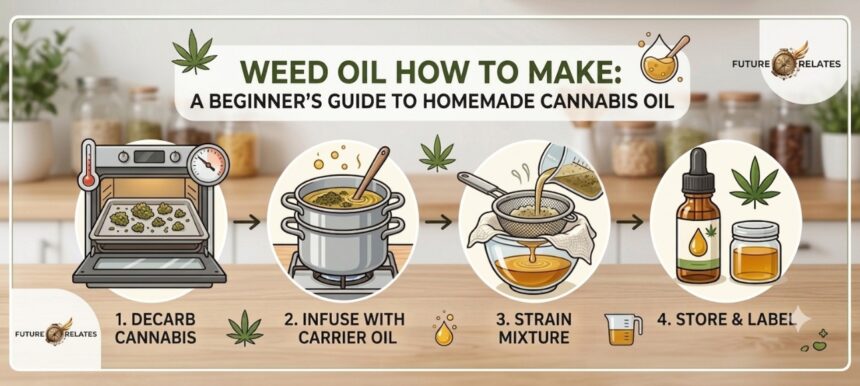
Here’s the full weed oil how to make process, broken into five easy steps.
Step 1: Decarb the cannabis
Spread ground flower on a parchment-lined tray. Bake at 220–245°F for 30–40 minutes.
Step 2: Heat the carrier oil
Add 1 cup of oil to a double boiler or slow cooker and warm it gently.
Step 3: Infuse cannabis on low heat
Stir in your decarbed flower. Keep the heat low, between 160–200°F, and let it steep for 2–6 hours. Stir occasionally.
Step 4: Strain the oil
Pour the mixture through cheesecloth into a clean jar. Let gravity do the work, don’t squeeze too hard.
Step 5: Cool and store
Let it cool completely, then seal it up. Done!
Best Temperature and Time for Cannabis Oil Infusion
Temperature control is everything here.
Ideal infusion range
Stick to 160–200°F for 2–6 hours. Slow and steady wins.
Why low heat matters
Gentle heat protects delicate compounds and gives you a smoother, more consistent oil.
How to avoid burning cannabinoids and terpenes
Never boil it. High heat degrades cannabinoids and terpenes like limonene and myrcene, which means weaker, harsher oil.
How to Strain and Store Homemade Cannabis Oil
Cheesecloth vs mesh strainer
Cheesecloth catches the fine bits best. A fine mesh strainer or coffee filter works too.
Best storage container
An airtight glass jar. Plastic isn’t ideal for the long haul.
How long weed oil lasts
Stored well, homemade weed oil can last 12–18 months.
Refrigeration vs room temperature storage
A cool, dark cupboard is fine short-term. The fridge extends freshness even more. Keep it away from light, heat, and air.
How to Dose Homemade Weed Oil
What’s interesting is that dosing trips up more beginners than the recipe itself.
Start low and go slow
Begin with a 2.5–5 mg microdose. You can always take more. You can’t take less once it’s in.
Estimating THC per teaspoon
A rough guide: strong homemade oil can land near 18 mg THC per teaspoon. Yours will vary based on your flower.
Factors that affect potency
Strain, THC percentage, infusion time, and your own body chemistry all play a role.
Why edibles feel stronger than smoking
When you eat weed oil, your body converts THC into 11-hydroxy-THC, which hits harder and lasts longer. That’s why edibles sneak up on people.
How to Use Cannabis Oil
One jar, so many options!
Cooking and baking
Brownies, cookies, cakes, and other homemade edibles.
Drizzling and dressings
Finish pasta, salads, or focaccia with a flavorful drizzle.
Sublingual use
A few drops under the tongue for faster onset.
Topical use
Rub it onto sore muscles for localized relief.
Capsules and beverages
Fill capsules for easy dosing, or stir it into tea, coffee, or a smoothie.
Cannabis Oil vs CBD Oil: What’s the Difference?
These two get mixed up constantly, so let’s clear it up.
THC-rich oil vs CBD-rich oil
Cannabis oil usually carries THC and gives psychoactive effects. CBD oil focuses on CBD.
Hemp-derived CBD oil
Most CBD oil comes from hemp, which has very little THC.
Psychoactive vs non-psychoactive effects
Cannabis oil can get you high. CBD oil generally won’t. They are not the same thing.
Cannabis Oil vs Cannabutter
Which one is better for recipes
Oil wins for versatility. It slides into both sweet and savory dishes with ease.
Flavor, texture, and flexibility
Butter shines in baked goods, but oil is more flexible across the board.
When to use oil instead of butter
Choose oil for dressings, sautéing, capsules, or anything dairy-free.
Common Mistakes to Avoid When Making Weed Oil
Skipping decarboxylation
The number one mistake. No decarb means weak oil.
Using too much heat
Blasting the heat kills potency and flavor.
Overcooking the infusion
Longer isn’t always better. Stay within 2–6 hours.
Poor straining
Leftover plant matter makes bitter, gritty oil.
Incorrect dosing
Guessing leads to unpleasant surprises. Estimate and start low.
Is Hash Oil the Same as Weed Oil?
Nope, and this matters.
Cooking oil infusions vs concentrates
Weed oil is a gentle infusion. Hash oil is a concentrated extract, far more potent.
Why solvent-made hash oil is a different category
Hash oil is often made with solvents to strip out cannabinoids. Totally different process.
Safety concerns with butane extraction
Butane extraction is flammable and carries real explosion risk. Leave that to the pros with proper equipment.
Can You Make Weed Oil for Vape Pens?
Short answer: don’t.
Why vape oil is a separate formulation
Vape oil is built specifically to be inhaled and requires different processing.
Cannabis cooking oil vs vape oil
Your edible weed oil is made for eating, not heating in a vape coil.
Why edible oil should not be confused with inhalable products
Inhaling cooking oil can harm your lungs. Keep edible oil for edibles, full stop.
FAQ About Making Weed Oil
Can you use fresh cannabis?
You can, but it must be dried and decarbed first for active effects.
What is the best oil for edibles?
Coconut oil for potency, olive oil for flavor and versatility.
How much weed per cup of oil?
A solid beginner ratio is 7 grams of cannabis to 1 cup of oil.
How long does it take to kick in?
Usually 30–90 minutes, with effects lasting a few hours.
Can you freeze weed oil?
Yes! Freezing extends shelf life and preserves potency.
Can you make weed oil without a slow cooker?
Absolutely. A double boiler or a saucepan on low heat works great.
Final Thoughts on Making Weed Oil at Home
Learning weed oil how to make is really about patience and gentle heat, nothing fancy.
Keep it simple
Stick to the basic steps and trust the process.
Focus on temperature control
Low and slow protects every bit of value in your flower.
Start with a low dose
A 2.5–5 mg microdose is the smartest way to begin.
Adjust potency over time
Once you know how your batch feels, tweak the ratio next round. Before long, you’ll have your own go-to recipe dialed in perfectly.
For More Information Visit: https://futurerelates.co.uk/