
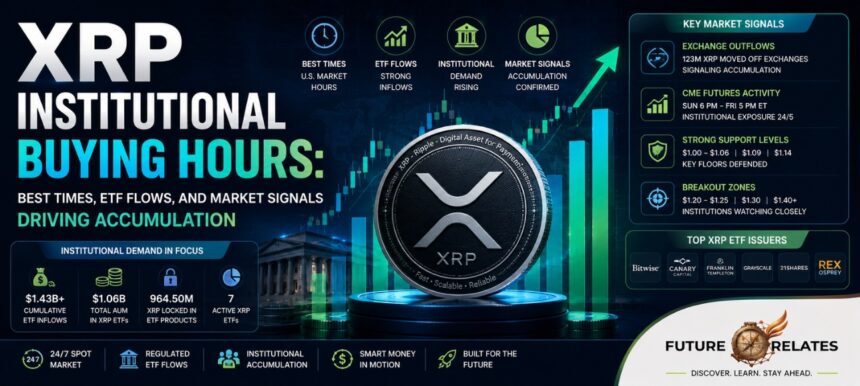

Let’s clear something up right away. When people search for “XRP institutional buying hours,” they’re not really asking for a clock reading. They want to know when big money moves, how it shows up, and what signals give it away. And honestly? That’s a smarter question than it looks.
- What Does “XRP Institutional Buying Hours” Actually Mean?
- Is XRP Traded 24/7 or Only During Institutional Market Hours?
- Why U.S. Trading Hours Matter for XRP Price Action
- How ETF Inflows Reveal Institutional XRP Demand
- XRP ETF Tracker Data: What the Largest Funds Show Right Now
- Exchange Outflows, Binance Accumulation, and Whale Behavior
- Key XRP Support and Resistance Levels Institutions Are Watching
- XRP Futures, Open Interest, and Around-the-Clock Institutional Exposure
- Ripple Infrastructure vs Direct XRP Buying: What’s the Difference?
- How the CLARITY Act Could Change XRP Institutional Demand
- XRP Volume Spikes and Session-Based Breakouts
- The Role of RLUSD, MXNB, and Cross-Border Payment Liquidity
- When Do Big Banks Actually Buy XRP?
- XRP Institutional Buying Hours vs Retail Trading Hours
- Final Take: How to Interpret XRP Institutional Buying Signals
- FAQs
Because XRP institutional buying hours aren’t just about time of day. They’re a mix of U.S. trading sessions, ETF creation windows, exchange flow timing, and quiet smart-money positioning. Let’s walk through all of it together.
What Does “XRP Institutional Buying Hours” Actually Mean?
Defining the term through sessions, ETF windows, and smart-money flow
Here’s the thing. XRP trades 24/7, but the people with the deepest pockets don’t. Institutions operate on schedules tied to regulated products, market opens, and settlement systems. So “XRP institutional buying hours” really means the windows where institutional demand becomes visible — through ETF inflows, exchange outflows, futures open interest, and price defending key support zones.
In short, you’re reading footprints. Not a calendar.
|
Signal |
What It Tells You |
Typical Timing Window |
|---|---|---|
|
ETF inflows |
Regulated demand entering |
U.S. market hours |
|
Exchange outflows |
Supply leaving for custody |
Around accumulation phases |
|
CME futures activity |
Institutional positioning |
Sun 6 p.m. – Fri 5 p.m. ET |
|
Volume surges |
Concentrated buying/selling |
U.S. morning hours |
|
Support defense |
Buyers stepping in |
Session lows |
Is XRP Traded 24/7 or Only During Institutional Market Hours?
Spot trading, ETF hours, and CME futures schedules
Spot XRP never sleeps. You can buy it on Binance, Bitstamp, or Bitrue at 3 a.m. on a Sunday if you want. That’s the beauty of crypto — around-the-clock access.
But institutions? Different story. XRP ETFs only trade when the NYSE and Nasdaq are open. And CME XRP futures run nearly continuously from Sunday 6:00 p.m. ET to Friday 5:00 p.m. ET, with a daily maintenance break. So the “buying hours” for regulated capital are narrower than the 24/7 spot market retail traders enjoy.
Why U.S. Trading Hours Matter for XRP Price Action
Morning sessions, opens, and volume surges
What’s interesting is how often XRP momentum lines up with U.S. morning hours. CoinDesk has tied XRP upside directly to stronger spot demand during specific U.S. sessions. When American desks wake up, liquidity thickens, and volume tends to expand.
That’s why session opens matter. A breakout at 9:30 a.m. ET with real volume behind it carries more weight than a thin overnight wick. Institutions are simply more active when their regulated venues are live.
How ETF Inflows Reveal Institutional XRP Demand
Cumulative inflows, AUM, and XRP locked
ETF flow data is probably the cleanest window into institutional appetite. Here’s what the numbers have shown across recent reports:
- Around $1.1B in net assets accumulated since mid-November (CoinDesk)
- Cumulative inflows near $1.43B to $1.47B in other reports
- FXLeaders cited $1.55B+ cumulative inflows by end of May
XRP Insights data added more color: roughly $1.06B in AUM, 964.50M XRP locked, 7 ETFs, and a 90-day volume of $1.76B. When ETF creations happen, XRP gets pulled off the open market and locked into fund reserves — which quietly shrinks circulating exchange supply.
XRP ETF Tracker Data: What the Largest Funds Show Right Now
Bitwise, Canary, Franklin Templeton, Grayscale, 21Shares, REX-Osprey
The lineup of issuers here reads like a who’s-who of asset management. Bitwise, Canary Capital, Franklin Templeton, Grayscale, 21Shares, and REX-Osprey all sit in the XRP investment product space. Each one brings its own creation-and-redemption engine, and together they shape how much regulated demand hits XRP on any given day.
To be honest, watching combined ETF AUM climb tells you more than any single fund’s headline. It’s the aggregate that signals conviction.
Exchange Outflows, Binance Accumulation, and Whale Behavior
Off-exchange movement and neutral readings
Now here’s a fun one. Exchange outflows rose from 40.7M XRP to 123M XRP in one stretch — a classic sign that supply is leaving exchanges and heading into cold storage or custody. That’s textbook accumulation behavior.
Meanwhile, the Binance institutional accumulation index moved back to -0.0059. Sounds bearish, right? Not quite. A reading that hovers near neutral suggests a pause and reassessment, not a full-blown distribution phase. Sometimes “boring” is just smart money catching its breath.
Key XRP Support and Resistance Levels Institutions Are Watching
Mapping the price floors and breakout zones
Big buyers love clean levels. Here’s the map traders keep referencing:
Support zones: $1.00–$1.06, $1.08, $1.09, $1.14, and the deeper $1.30–$1.3200 band.
Resistance zones: $1.18–$1.19, $1.20–$1.25, $1.30, $1.40, $1.45, and $1.50.
When XRP defends $1.00 or reclaims $1.20 with volume, that’s the kind of structural support and breakout confirmation institutions watch closely.
XRP Futures, Open Interest, and Around-the-Clock Institutional Exposure
CME futures and cash-settled positioning
Not every institution wants to hold spot XRP in custody. Some prefer cash-settled CME XRP futures and Micro XRP futures instead. It’s cleaner from a compliance angle. Rising open interest during futures hours signals that institutions are positioning without ever touching a private key. That’s exposure without custody headaches.
Ripple Infrastructure vs Direct XRP Buying: What’s the Difference?
Payment rails, RLUSD, and actual token holding
This trips a lot of people up. Using Ripple’s payment rails, RippleNet, or On-Demand Liquidity does not automatically mean a company is buying and holding XRP. Some partners lean on software rails or RLUSD instead of the token itself.
So when you see a “Ripple partnership” headline, pause. Ask whether it involves real XRP accumulation or just infrastructure. The difference matters a lot for demand.
How the CLARITY Act Could Change XRP Institutional Demand
Regulatory clarity and commodity classification
Regulation is the quiet catalyst here. The CLARITY Act and clearer commodity classification could remove a big hesitation for pension funds, RIAs, and asset managers. Once XRP’s legal framework feels settled, institutional legitimacy grows — and with it, broader participation. Clarity opens doors that uncertainty keeps shut.
XRP Volume Spikes and Session-Based Breakouts
Why volume near key hours signals more than retail hype
Remember the breakout when volume surged at June 11, 17:00 UTC? That kind of time-anchored spike is a useful clue. When volume runs 160% above average or spikes 212% near a U.S. session, it usually points to concentrated buying — not scattered retail clicks. Volume confirmation near known hours separates real moves from noise.
The Role of RLUSD, MXNB, and Cross-Border Payment Liquidity
Stablecoins supporting the XRPL narrative
RLUSD and MXNB add enterprise settlement and on-chain liquidity to the XRP Ledger story. These stablecoins support real cross-border payment use cases, strengthening the broader ecosystem. More utility on the XRPL means more reasons for institutions to stay engaged over time.
When Do Big Banks Actually Buy XRP?
Direct exposure vs distribution programs
Straight answer: it varies. Some banks gain exposure through ETFs, some through trading desk inventory, and some through customer-facing programs. A standout example — SBI Shinsei Bank exposed roughly 4.33M accounts to XRP redemption options, a major distribution signal. And Ripple’s Hidden Road acquisition was framed as a bridge into institutional finance. That’s real infrastructure, not just talk.
XRP Institutional Buying Hours vs Retail Trading Hours
24/7 access vs narrow visibility windows
Retail can trade anytime. Institutions can too, technically — but their activity concentrates where regulated products and U.S. sessions overlap. So while the market is always open, institutional capital is most visible during defined windows. Retail sees the door open 24/7; institutions walk through during business hours.
Final Take: How to Interpret XRP Institutional Buying Signals
The most reliable indicators to track
So what should you actually watch? Keep it simple:
- ETF flows — cumulative inflows and AUM growth
- Exchange outflows — supply leaving for custody
- Support defense — buyers holding key floors
- Futures activity — rising open interest
- Volume timing — surges during U.S. hours
Stack these together and the XRP institutional buying hours story becomes a lot clearer. It’s less about the clock and more about the footprints big money leaves behind.
FAQs
1. What are XRP institutional buying hours?
They’re the windows where institutional demand becomes visible — mainly U.S. trading sessions, ETF creation windows, and CME futures hours — rather than a fixed time of day.
2. Does XRP trade 24/7?
Yes. Spot XRP trades around the clock. But ETFs and CME futures follow set schedules.
3. When do institutions usually buy XRP?
Most visible activity clusters during U.S. morning hours and regulated market sessions.
4. Do XRP ETF inflows affect XRP price?
They can. ETF creations lock XRP into fund reserves, reducing circulating exchange supply.
5. What is the best time to track XRP accumulation?
Watch U.S. session opens and ETF flow reports, plus exchange outflow data.
6. Are big banks actually buying XRP?
Some gain exposure via ETFs or trading desks. SBI Shinsei Bank exposed 4.33M accounts to XRP redemption options.
7. What are the key XRP support and resistance levels?
Support sits near $1.00–$1.14 and $1.30–$1.32. Resistance spans $1.18 up to $1.50.
8. How do exchange outflows signal XRP accumulation?
Rising outflows — like 40.7M to 123M XRP — suggest supply moving into custody, a common accumulation sign.
9. What role does the CLARITY Act play in XRP demand?
It could bring regulatory clarity and commodity classification, lowering barriers for institutional participation.
10. What is the difference between buying XRP directly and buying an XRP ETF?
Direct buying means holding the token yourself. An ETF gives regulated exposure through a fund wrapper, only during market hours.
For More Information Visit: https://futurerelates.co.uk/